


Those of us of a certain age might remember the nightly PSA: “It’s 10 p.m., do you know where your children are?” Today, advisors could ask a similar question: “Recently, the 10-year hit above 5%, do you know where your bond fund is?” Among bond funds, the multisector group may be an especially willful child:
Advisors typically allocate to this class of funds to allow their portfolio managers to make calls on rates and credit on their behalf.
Assets in these funds have increased 70% in the last 5 years.
In September, the 10-year Treasury rose to above 5% for the first time in nearly two decades while high yield spreads are near all-time tight levels.
The Portfolio Consulting Team of Principal Asset Management continually monitors portfolios to identify trends in asset flows and positioning. Based on our analysis and recent market action, it's our perspective that some multisector bond funds might be out past their bedtime. As with all willful children, at the very least, a little well-timed oversight could be prudent.
The reasons for including bonds in a portfolio justifiably vary—reducing equity volatility, generating income, and accessing opportunity among them. Multisector bond funds varied widely in how well they met these goals, reflecting differences in their holdings. To evaluate them, how they were positioned, and how they performed, we looked at three key areas:
- Timing duration
- Exposure to high yield credit
- Total return versus a static portfolio of T-Bills and high yield bonds
Historical duration
Looking back on the historical duration of the category’s largest 25 funds one can see a less than glowing track record for timing duration changes. Fund duration rose to a local peak in September 2020, seemingly at a time when it would have been more advantageous to reduce it—the 10-year’s yield reached an all-time low only two months before. Duration then rose alongside rates during 2022, when it might have been prudent to go in the opposite direction, at least until the Federal Reserve’s rate hiking cycle ended.
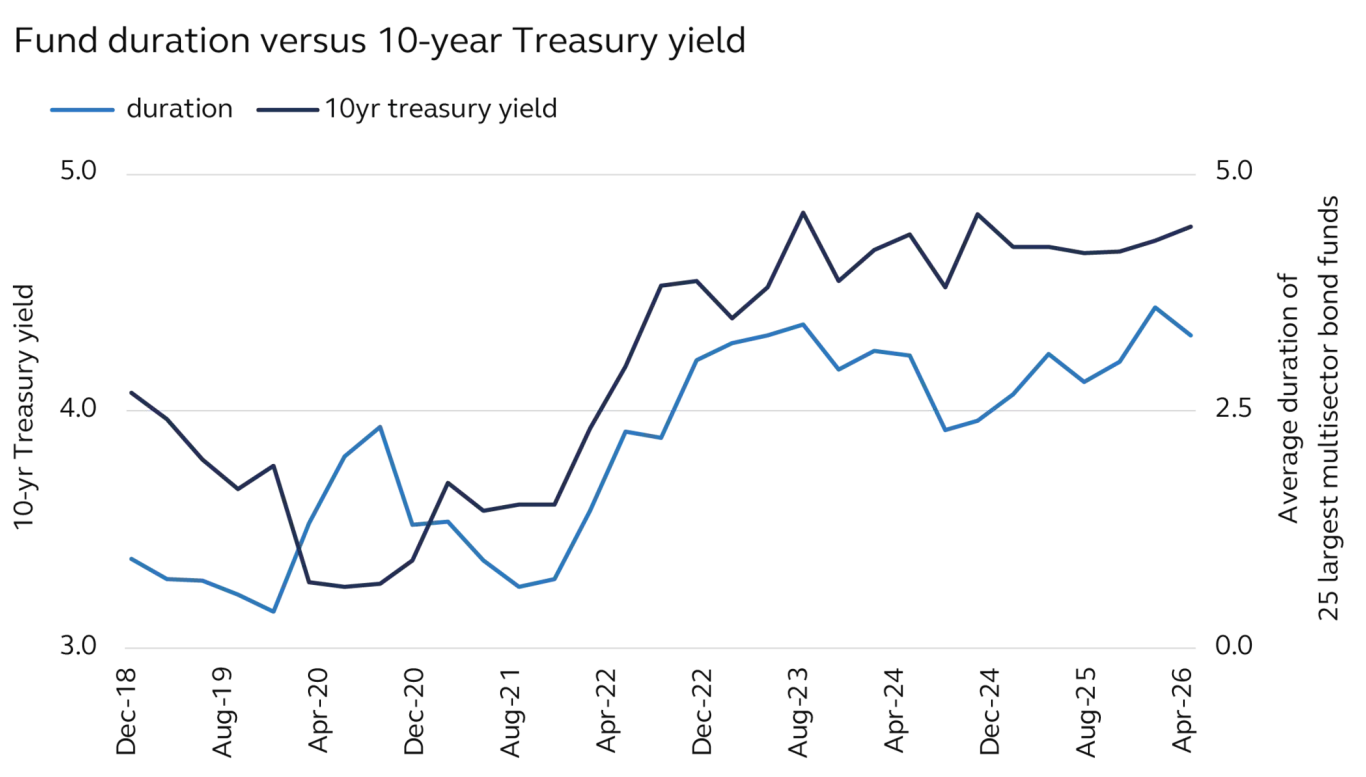
Source: Morningstar. Data as of 09/30/2026.
High yield credit exposure
Historical allocations to high yield credit tell a similar story. As spreads peaked in March 2020 (around the covid-induced selloff), exposure to high yield bonds declined. They then peaked in mid-2021—six quarters after the peak in spreads. It’s also worth noting that on average, the top 25 multisector bond funds had no less than a third of their assets in riskier high yield bonds regardless of where spreads traded.
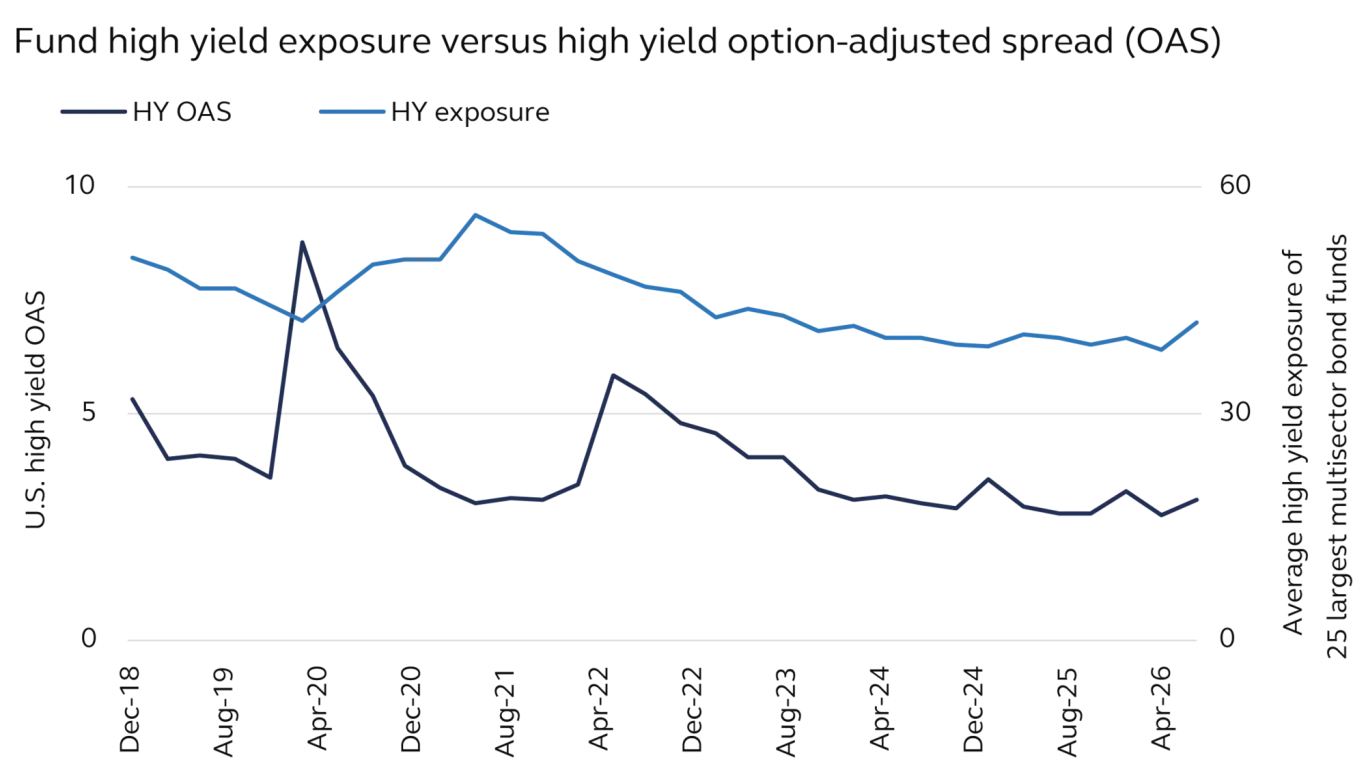
Sources: Source: Morningstar. Data as of 09/30/2026.
5-year returns
Parents and bond investors alike know that sometimes the simplest solution to keeping things in check is often the best. Over the 5-year period ending September 30, 2026, a portfolio of 50% T-bills and 50% high yield bonds would have outperformed the largest 25 multisector bond funds on average. The 50/50 portfolio’s 18.25% total return would have ranked better than 80% of multisector bond funds for the period.
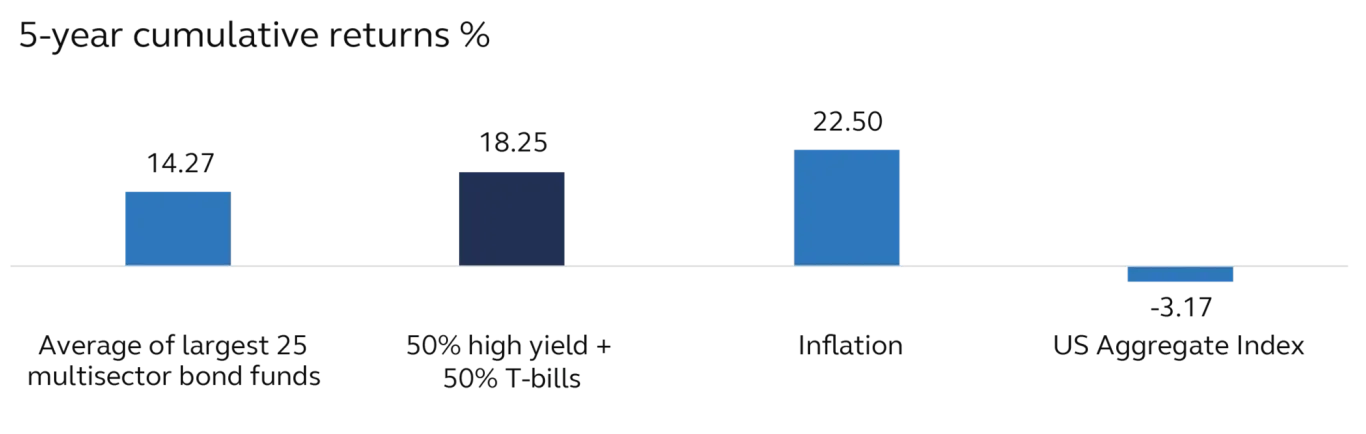
Sources: Morningstar Direct (multi-sector bond funds, U.S. Aggregate Index), Ycharts (50-50 portfolio), Federal Reserve Bank of St. Louis (Inflation) as of 09/30/2026.
It’s worth noting that multisector bond funds can have a strategic role in an investor’s portfolio as they can outpace traditional fixed income. An investor who earned the average 14.27% of the largest 25 funds noted above would have significantly outpaced the Aggregate Bond index which returned -3.17% over the same period. Yet in an environment where inflation compounded at more than 4% per year, both the average multisector bond investor and the simple 50/50 portfolio would have fallen short of outpacing inflation, so assessing alternatives to even a multisector approach is a worthy exercise.
With rates volatile and multi-sector strategies sometimes out of synch with markets, a simpler solution may have a place in clients’ portfolios. For example, rate-insensitive collateralized loan obligations (CLOs) and/or Treasury Inflation-Protected Securities (TIPS) can serve as notable complements to multisector bond allocations or traditional bond allocations. At minimum, it’s perhaps a good time to keep an eye on the willful child in many client portfolios.
Rates are over 5% for the first time since 2007. Do you know where your multisector bond fund is?
Partner with the Portfolio Consulting Team at Principal Asset Management to gain objective, data driven insights that can strengthen your investment process and enhance client conversations. Our advanced risk analytics help you identify potential portfolio vulnerabilities through comprehensive stress testing and product-agnostic risk assessments with a focus on active risk. Whether you’re evaluating existing portfolios or building new investment models, our team works alongside you to develop solutions aligned with your investment philosophy, preferred holdings, and clients’ goals. We help simplify complex portfolio analysis, saving you time while providing actionable insights that support more informed decision-making.
IMPORTANT: The projections generated by the investment analysis tool utilized by the Principal Portfolio Consulting Team (PCT) regarding the likelihood of various investment outcomes are hypothetical in nature, do not reflect actual investment results, and are not guarantees of future results. Results may vary with each use and over time. Past performance is no guarantee of future results and should not be relied upon to make an investment decision. There is no assurance that forward-looking projections will occur and actual conditions and outcomes may be significantly different than projected. The information presented should not be construed as investment advice or a recommendation for the purchase or sale of any security. The general information it contains does not take account of any investor’s investment objectives, particular needs, or financial situation. PCT may provide certain asset allocation blends to financial advisors and assist with model portfolio customizations directed by those advisors. Any and all example allocations are provided for the advisors’ informational purposes only, are for use only by the advisors, and are not intended for use with any specific client of an advisor.
Risk considerations
Investing involves risk, including possible loss of principal. Past Performance does not guarantee future return.
Important information
This material covers general information only and does not take account of any investor’s investment objectives or financial situation and should not be construed as specific investment advice, a recommendation, or be relied on in any way as a guarantee, promise, forecast or prediction of future events regarding an investment or the markets in general. Information presented has been derived from sources believed to be accurate; however, we do not independently verify or guarantee its accuracy or validity. Any reference to a specific investment or security does not constitute a recommendation to buy, sell, or hold such investment or security, nor an indication that the investment manager or its affiliates has recommended a specific security for any client account. Subject to any contrary provisions of applicable law, the investment manager and its affiliates, and their officers, directors, employees, agents, disclaim any express or implied warranty of reliability or accuracy and any responsibility arising in any way (including by reason of negligence) for errors or omissions in the information or data provided. This material may contain ‘forward‐looking’ information that is not purely historical in nature and may include, among other things, projections, and forecasts. There is no guarantee that any forecasts made will come to pass. Reliance upon information in this material is at the sole discretion of the reader. This material is not intended for distribution to or use by any person or entity in any jurisdiction or country where such distribution or use would be contrary to local law or regulation.
Index definitions
Multisector bond funds: Morningstar defines a multisector bond fund is a fixed‑income portfolio that seeks income by investing across multiple bond sectors—typically U.S. government, corporate, foreign, and high‑yield debt—with 35%–65% of assets in below‑investment‑grade securities. The US Aggregate Index is a broad-based benchmark that tracks the performance of investment-grade, U.S. dollar-denominated, fixed-rate bonds across multiple sectors.
© 2026 Principal Financial Services, Inc. Principal®, Principal Financial Group®, Principal Asset Management, and Principal and the logomark design are registered trademarks and service marks of Principal Financial Services, Inc., a Principal Financial Group company, in various countries around the world and may be used only with the permission of Principal Financial Services, Inc.
Principal Asset Management® is a trade name of Principal Global Investors, LLC.
MM15024A | 11/2026 | 6078244-112027
Footnotes
Morningstar. Data as of 09/30/2026.
Morningstar. Data as of 09/30/2026.