


EXECUTIVE SUMMARY
U.S. investment grade private corporate credit, debt issued directly to a small group of institutional lenders rather than sold on the public bond market, is seeing increased interest from asset allocators. The market predates the below-investment grade direct lending market by decades, driven largely by life insurers as a core fixed income allocation.
Issuance reached a record $211.1 billion in 2025, up 33% from 2024,
Recent growth is not simply a function of higher yields. It reflects a deliberate reallocation by long-duration institutional investors toward an asset class that also offers negotiated covenants, tailored structuring, and, for insurers, capital treatment equivalent to a comparable public bond.
U.S. investment grade private credit describes debt that is originated, underwritten, and rated to investment grade standards as a “Reg D” bond or note then placed directly with a limited group of institutional lenders rather than sold on the public bond market. The securities are commonly referred to by industry investors as U.S. private placement (USPP). Deals are arranged either directly with borrowers or through agent banks that bring an issuer to a panel of private lenders.
The label sits alongside, and is often confused with, “private credit” more broadly, a term that has recently often come to be associated with direct lending to primarily below investment grade borrowers.
Investment grade private placements are a more established market. Life insurers have used them as a core fixed income allocation for decades, well before either the terms “private credit” or “private placement” entered common use, and practitioners increasingly add “IG” to the front of their own activity to draw that distinction. Used broadly, the term spans corporate placements, infrastructure debt, and privately placed asset-backed securities, each treated as a distinct sub-platform. This article focuses on corporate placements, the market’s original and largest segment.
Two forces have converged that may make this a compelling entry point for institutional allocators.
The first is straightforward: rates. A bond priced at a fixed spread over Treasuries becomes more attractive in absolute yield terms as the underlying rate rises. A note issued at 130 basis points (bps) over a 2% ten-year Treasury yields 3.3% – the same spread over a ten-year Treasury above 4.5% yields something closer to 6%. Higher yields, which also provide better downside risk mitigation, are attracting a wider set of buyers.
The second is a deliberate portfolio decision by the market’s largest buyers. Life insurers have reallocated a meaningful share of general account assets away from liquid public bonds toward less liquid, higher-yielding private placements, a considered trade of liquidity for spread rather than an opportunistic reach for yield.
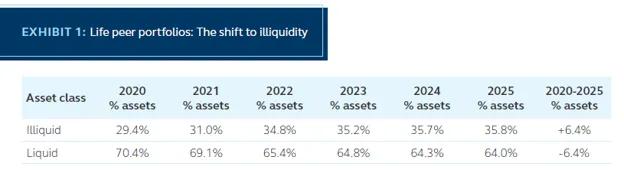
Source: Principal Asset Management Research, S&P Global, Neuberger, 31 December 2025.
Borrower demand has broadened alongside that reallocation, with financial sector and asset-backed placements growing faster than the market’s traditional industrial and utility base,
Momentum has continued into 2026. Issuance through June reached $125 billion, the strongest opening six months on record.
We believe the present environment may be a particularly constructive entry point for the asset class.
Higher base rates have lifted all-in yields without requiring investors to move down the credit spectrum. Insurers continue to reallocate from public to private fixed income, a shift that shows no sign of having run its course. Issuance momentum has carried into 2026, with borrower demand broadening across sectors and structures. New issuance in financial and asset-backed segments is expanding the opportunity set for investors seeking diversification beyond the market’s traditional industrial base.
To fully realize the benefits of private placements, investors should evaluate several implementation considerations. Liquidity, while typically lower than in public fixed income markets, is often aligned with the long-term investment horizons of many institutional investors. Manager selection also plays an important role, as sourcing capabilities, underwriting expertise, and covenant negotiation can influence portfolio outcomes. Additionally, investors should continue to evaluate market conditions and covenant trends as the asset class evolves. Thoughtful sizing of allocations relative to portfolio objectives and liquidity needs can help investors effectively capture the potential benefits of the asset class.
U.S. private placements occupy a distinct place in an institutional fixed income allocation, underwritten with the discipline of a public bond and negotiated with the protections of a private loan.
| Public IG Bonds | U.S Private Placement | |
|---|---|---|
| Documentation | Standardized | Negotiated |
| Covenants | Rare | Financial maintenance and change-of-control protection |
| Secondary Liquidity | Broad, exchange-adjacent | Limited broker-facilitated typical among existing holders |
| Spread | Public market level | Premium, varying by sector and structure |
| Workout influence | Dispersed bondholder base | Concentrated lender group, direct negotiation |
| Capital treatment (insurers) | Rating-dependent | Same rating-dependent schedule as public bonds |
Allocation decisions should reflect a clear trade-off between yield, liquidity, and structural protection, combined with the sourcing capability required to access the market in the first place.
For institutions with the ability to hold to maturity and the governance to evaluate negotiated documentation, either directly or through an experienced private debt asset manager, U.S. private placements may offer a way to increase income, yield and downside risk mitigation within an investment-grade allocation in today’s market without overreliance on more speculative-grade lending. Maturities cluster between seven and twelve years, though the full range extends from short-dated notes to structures beyond thirty years, giving allocators room to match private placement exposure to specific liability profiles.
Conclusion
USPPs have moved from a specialist allocation to a more mainstream component of institutional fixed income portfolios, driven by a rate environment that rewards locked-in spread premiums, an issuer base broadening beyond the market’s traditional industrial core, and a buyer base extending beyond the U.S. insurance companies that built the market.
The asset class offers a combination of potential benefits that is difficult to find elsewhere in investment grade credit: a proven spread premium, negotiated structural protection, sector and currency diversification, better recoveries in distress, and, for regulated buyers, highly efficient capital treatment. As the market continues to grow into new sectors and structures, disciplined manager selection will determine which investors capture that combination most effectively.
Footnotes
Private Placement Monitor DataField, Full Year 2025 – Recap of Market Activity, December 2025.
Private Placement Monitor DataField, May Year-to-Date Issuance 2016–2026, June 2026.
Federal Reserve Bank of Chicago, Life Insurers’ Private Credit Investments and Annuity Market Share Capture, June 2025.
Federal Reserve Bank of Chicago, Life Insurers’ Private Credit Investments and Annuity Market Share Capture, June 2025.
Private Placement Monitor DataField, May Year-to-Date Issuance 2016–2026, June 2026.
Private Placement Monitor DataField, May Year-to-Date Issuance 2016–2026, June 2026.
Risk Considerations
Investing involves risk, including possible loss of principal. Past Performance does not guarantee future return. All financial investments involve an element of risk. Therefore, the value of the investment and the income from it will vary and the initial investment amount cannot be guaranteed. Private placements are subject to liquidity risk, credit risk, valuation uncertainty, and issuer-specific risks. Historical spread premiums, recovery rates, covenant protections, and loss experience may not be repeated in future market environments. The strategy’s objective of downside risk reduction/protection may or may not be successful and as a result investors must be prepared to bear capital losses, including a loss of capital invested. Private credit involves an investment in non-publicly traded securities which are subject to illiquidity risk. Portfolios that invest in private credit may be leveraged and may engage in speculative investment practices that increase the risk of investment loss.
Important information
This material covers general information only and does not take account of any investor’s investment objectives or financial situation and should not be construed as specific investment advice, a recommendation, or be relied on in any way as a guarantee, promise, forecast or prediction of future events regarding an investment or the markets in general. The opinions and predictions expressed are subject to change without prior notice. The information presented has been derived from sources believed to be accurate; however, we do not independently verify or guarantee its accuracy or validity. Any reference to a specific investment or security does not constitute a recommendation to buy, sell, or hold such investment or security, nor an indication that the investment manager or its affiliates has recommended a specific security for any client account.
Subject to any contrary provisions of applicable law, the investment manager and its affiliates, and their officers, directors, employees, agents, disclaim any express or implied warranty of reliability or accuracy and any responsibility arising in any way (including by reason of negligence) for errors or omissions in the information or data provided. All figures shown in this document are in U.S. dollars unless otherwise noted.
This material may contain ‘forward looking’ information that is not purely historical in nature. Such information may include, among other things, projections, and forecasts. There is no guarantee that any forecasts made will come to pass. Reliance upon information in this material is at the sole discretion of the reader.
This material is not intended for distribution to or use by any person or entity in any jurisdiction or country where such distribution or use would be contrary to local law or regulation.
This document is issued in:
- The United States by Principal Global Investors, LLC, which is regulated by the U.S. Securities and Exchange Commission.
- Europe by Principal Global Investors (Ireland) Limited, 70 Sir John Rogerson’s Quay, Dublin 2, D02 R296, Ireland. Principal Global Investors (Ireland) Limited is regulated by the Central Bank of Ireland. Clients that do not directly contract with Principal Global Investors (Europe) Limited (“PGIE”) or Principal Global Investors (Ireland) Limited (“PGII”) will not benefit from the protections offered by the rules and regulations of the Financial Conduct Authority or the Central Bank of Ireland, including those enacted under MiFID II. Further, where clients do contract with PGIE or PGII, PGIE or PGII may delegate management authority to affiliates that are not authorized and regulated within Europe and in any such case, the client may not benefit from all protections offered by the rules and regulations of the Financial Conduct Authority, or the Central Bank of Ireland. In Europe, this document is directed exclusively at Professional Clients and Eligible Counterparties and should not be relied upon by Retail Clients (all as defined by the MiFID).
- This document is marketing material and is issued in Switzerland by Principal Global Investors (Switzerland) GmbH.
- United Kingdom by Principal Global Investors (Europe) Limited, Level 1, 1 Wood Street, London, EC2V 7 JB, registered in England, No. 03819986, which is authorized and regulated by the Financial Conduct Authority (“FCA”).
- United Arab Emirates by Principal Investor Management (DIFC) Limited, an entity registered in the Dubai International Financial Centre and authorized by the Dubai Financial Services Authority as an Authorised Firm, in its capacity as distributor/promoter of the products and services of Principal Asset Management. This document is delivered on an individual basis to the recipient and should not be passed on or otherwise distributed by the recipient to any other person or organisation.
- Singapore by Principal Global Investors (Singapore) Limited (ACRA Reg. No. 199603735H), which is regulated by the Monetary Authority of Singapore and is directed exclusively at institutional investors as defined by the Securities and Futures Act 2001. This advertisement or publication has not been reviewed by the Monetary Authority of Singapore.
- Australia by Principal Global Investors (Australia) Limited (ABN 45 102 488 068, AFS Licence No. 225385), which is regulated by the Australian Securities and Investments Commission and is only directed at wholesale clients as defined under Corporations Act 2001.
- Hong Kong SAR by Principal Asset Management Company (Asia) Limited, which is regulated by the Securities and Futures Commission. This document has not been reviewed by the Securities and Futures Commission. This document may only be distributed, circulated or issued to persons who are Professional Investors under the Securities and Futures Ordinance and any rules made under that Ordinance or as otherwise permitted by that Ordinance.
- Other APAC Countries/Jurisdictions, this material is issued for institutional investors only (or professional/sophisticated/qualified investors, as such term may apply in local jurisdictions) and is delivered on an individual basis to the recipient and should not be passed on, used by any person or entity in any jurisdiction or country where such distribution or use would be contrary to local law or regulation.
Principal Global Investors, LLC (PGI) is registered with the U.S. Commodity Futures Trading Commission (CFTC) as a commodity trading advisor (CTA), a commodity pool operator (CPO) and is a member of the National Futures Association (NFA). PGI advises qualified eligible persons (QEPs) under CFTC Regulation 4.7.
© 2026 Principal Financial Services, Inc. Principal®, Principal Financial Group®, Principal Asset Management, and Principal and the logomark design are registered trademarks and service marks of Principal Financial Services, Inc., a Principal Financial Group company, in various countries around the world and may be used only with the permission of Principal Financial Services, Inc. Principal Asset Management℠ is a trade name of Principal Global Investors, LLC.
MM15135 | 09/2026 | 5921377 -092028

No information