


The emergence of Artificial Intelligence (AI) is triggering rapid and structural change across the economy, and is shaping up to be a disruptive innovation that has the potential to leave a lasting mark on entire industries.
That promise has already fueled a powerful investment cycle and driven substantial gains in AI-linked assets. It has also raised a critical question: Can adoption and earnings growth develop quickly enough to justify the expectations already reflected in market prices?
The rollout of AI can be viewed through the technological adoption cycle, developed by organizational theorist and management consultant Geoffrey Moore in the 90s. This framework draws lessons from disruptive technological advances such as the railroad, telephones, or the internet and how they have spread through the fabric of society.
Underpinning the framework is the way technology diffuses from the early market to the mainstream market. There is a wide gap between these two segments which, in Moore’s technology adoption framework, is referred to as the “chasm.” As a result, not all disruptive technologies successfully climb the adoption curve.
However, if the disruptive technology does cross the chasm, momentum builds towards increased usage. This triggers a tornado of hypergrowth, characterized by mass-market adoption. At this stage, a company's ability to scale and meet growing demand matters most.
How adoption broadens from the early market to the mainstream market, illustrative
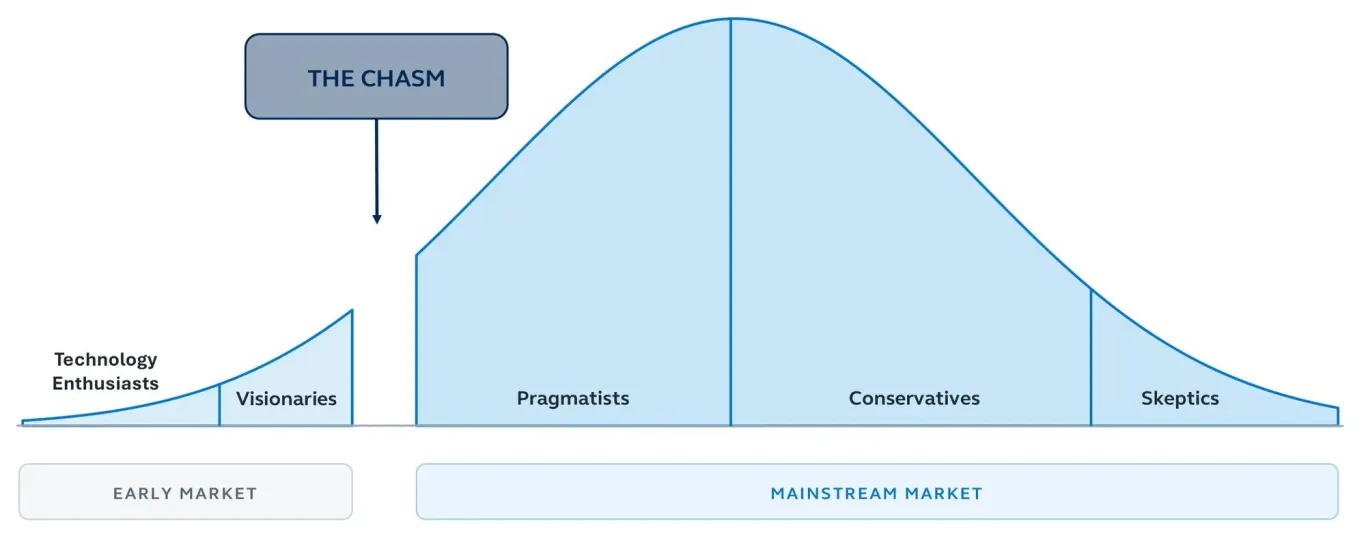
Note: Curve and segment widths are not based on underlying data. Source: Geoffrey A. Moore “Crossing the Chasm”, Principal Asset Management. For illustrative purposes only.
The reported use of AI in business functions has climbed to over 20% of firms in the U.S. There is also momentum building behind its use, driven in part by firms that do not want to risk missing out on the perceived benefits of AI. Indeed, with its potential use-case spanning almost all industries, a growing share of companies have indicated increased spending on AI tools.
Much of this spending is driven by potential cost savings and the increased availability of “out-of-the-box” solutions, suggesting that a real target market has emerged. All of these factors suggest that AI has likely crossed the chasm and entered a hypergrowth phase.
At this stage, there is inherent uncertainty about the size of the total addressable market. Indeed, questions remain about whether AI applications will be limited to agentic use or will extend to robotics, humanoids, and beyond. Therefore, during the hypergrowth phase, traditional valuation metrics do not matter. Instead, valuations are primarily driven by expectations of future growth.
As AI usage is expected to rise, there is an ongoing race between overall adoption and underlying growth expectations. At some point, these two forces will need to converge to match reality.
In the meantime, a potentially large spread between the two isn’t necessarily a negative catalyst by itself, though it highlights the magnitude of the risk that markets face if sentiment softens. In other words, while it is entirely possible that AI could become mainstream technology in the future, this could occur even if investor expectations today are overly high.
One measure of market expectations is the market-implied value of growth. This is the portion of enterprise value that is attributable to earnings growth beyond the sustainability of current earnings. The latter, known as earnings power value, is the portion of value based on current earnings, while ignoring assumptions about future growth. Taken together, these measures show that 70% of the value of the technology index today is based on expectations of future earnings growth.
A similar measure that looks at the market-implied future earnings growth rate indicates that earnings will need to grow by more than 8% per year in the long term to meet current expectations. On a relative basis, this is a significant deviation from proxies of long-term nominal growth, such as the yield of the 30-year Treasury. Moreover, this is over 2.5x the earnings growth rate markets were pricing in during the business cycle prior to the pandemic—when growth was expected at 3%—and is slowly approaching the peak rate seen during the 2000 dot-com bubble.
With so much of the sector’s valuation tied to future growth and expectations already at historically high levels, a key question for investors is what could cause those expectations to be revised.
The race between adoption and expectations can continue as long as the mainstream market expands, providing an anchor to market-implied growth rates.
However, a critical tipping point is reached once the market becomes saturated. This has historically coincided when half of the total addressable market has been acquired. At this stage, it becomes evident that there may not be enough room for everyone to compete in the market. Earnings and margin growth will likely begin to decelerate, competitive pressures will return, and traditional competitive advantages are tested.
The importance of market share increases as a winner-take-all dynamic emerges. The resulting AI market leader becomes the de facto standard because it can ultimately capture a disproportionate share of industry profits. Moreover, in this process, a valuation reset occurs as earnings sustainability is reemphasized and more traditional valuation tools come back into focus.
Looking ahead, identifying when AI begins to experience a deceleration in expected growth will be critical in managing risks. While doing so involves some uncertainties, there are some signals that investors can monitor:
- Surveys of AI adoption: While these provide a good directional indicator of where adoption is heading, they likely do not provide the whole story. Adoption is less about availability and more about intensity, so these measures do not necessarily need to reach exactly 50% adoption for the saturation point to be reached.
- Token consumption and prices: These indicators are useful proxies for enterprise AI adoption that incorporate intensity. As hyperscalers are ultimately monetized through AI token usage, these measures also highlight competitive pressures among AI providers. So far, the data point to low intensity of aggregate AI usage, with enterprises adopting AI but not yet scaling up their usage. Meanwhile, mixed competitive pressure among AI providers has become more prominent, with prices generally trending lower.
- Return on Invested Capital (ROIC): As the return of every capex dollar decelerates, it points to a diminishing opportunity set within the market. This can be due to weakening pricing power, rising costs, or increasing cost of capital. For highly capital-intensive hyperscalers, the latter appears most relevant in the current environment. With more AI capex funded by debt issuance, the emergence of a crowding-out effect that increases the overall cost of capital for AI firms would challenge project economics.
These indicators can help investors assess whether AI’s earnings potential is keeping pace with the growth already priced into markets. Adoption may continue to expand for years, but weaker pricing power or declining returns on investment could challenge valuations well before the market reaches saturation.
Consistent with history, AI is facing an ongoing race between rising adoption and evolving earnings growth expectations. These will need to converge at some point, and investors can look to the technological adoption cycle framework to help make sense of how valuations can shift in the process. Notably, the AI adoption cycle has only recently entered the mainstream market. This suggests that investors should be able to continue capitalizing on the growing momentum in adoption and should maintain AI exposure through the hypergrowth phase.
However, as 70% of the value of the technology index is now based on expectations about the future, it leaves the sector acutely exposed to shifting expectations. To manage risks, investors should closely monitor signs of market saturation and increasingly focus on businesses that can convert adoption gains into durable earnings growth.
Finally, once adoption matures, differentiation between AI winners and losers will only intensify. While this process may coincide with a broad market re-rating, the leaders in the AI race will ultimately recover, while losers will become irrelevant and fade away. Given how much is at stake for investors, active management and good stock selection through this adoption cycle will play a critical role in effectively capitalizing on this period of profound technological change while minimizing risks.
For Public Distribution in the U.S. For Institutional, Professional, Qualified and/or Wholesale Investor Use Only in other Permitted Jurisdictions as defined by local laws and regulations.
Risk considerations
Investing involves risk, including possible loss of principal. Past Performance does not guarantee future return. All financial investments involve an element of risk. AI companies face significant investment risks due to limited resources, intense competition, and rapid product obsolescence, making them particularly vulnerable to market volatility. Data center investment risks include power constraints and rising costs, technological obsolescence, potential overbuilding, regulatory hurdles, supply chain vulnerabilities, physical and cyber security threats, and increased competition. International investing involves greater risks such as currency fluctuations, political/social instability, and differing accounting standards. Equity markets are subject to many factors, including economic conditions, government regulations, market sentiment, local and international political events, and environmental and technological issues that may impact return and volatility.
Important information
This material covers general information only and does not take account of any investor’s investment objectives or financial situation and should not be construed as specific investment advice, a recommendation, or be relied on in any way as a guarantee, promise, forecast or prediction of future events regarding an investment or the markets in general. Information presented has been derived from sources believed to be accurate; however, we do not independently verify or guarantee its accuracy or validity. Any reference to a specific investment or security does not constitute a recommendation to buy, sell, or hold such investment or security, nor an indication that the investment manager or its affiliates has recommended a specific security for any client account. Subject to any contrary provisions of applicable law, the investment manager and its affiliates, and their officers, directors, employees, agents, disclaim any express or implied warranty of reliability or accuracy and any responsibility arising in any way (including by reason of negligence) for errors or omissions in the information or data provided.
This material may contain ‘forward‐looking’ information that is not purely historical in nature and may include, among other things, projections, and forecasts. There is no guarantee that any forecasts made will come to pass. Reliance upon information in this material is at the sole discretion of the reader.
This material is not intended for distribution to or use by any person or entity in any jurisdiction or country where such distribution or use would be contrary to local law or regulation.
This document is intended for use in:
- The United States by Principal Global Investors, LLC, which is regulated by the U.S. Securities and Exchange Commission.
- Europe by Principal Global Investors (Ireland) Limited, 70 Sir John Rogerson’s Quay, Dublin 2, D02 R296, Ireland. Principal Global Investors (Ireland) Limited is regulated by the Central Bank of Ireland. Clients that do not directly contract with Principal Global Investors (Europe) Limited (“PGIE”) or Principal Global Investors (Ireland) Limited (“PGII”) will not benefit from the protections offered by the rules and regulations of the Financial Conduct Authority or the Central Bank of Ireland, including those enacted under MiFID II. Further, where clients do contract with PGIE or PGII, PGIE or PGII may delegate management authority to affiliates that are not authorized and regulated within Europe and in any such case, the client may not benefit from all protections offered by the rules and regulations of the Financial Conduct Authority, or the Central Bank of Ireland. In Europe, this document is directed exclusively at Professional Clients and Eligible Counterparties and should not be relied upon by Retail Clients (all as defined by the MiFID).
- United Kingdom by Principal Global Investors (Europe) Limited, Level 1, 1 Wood Street, London, EC2V 7 JB, registered in England, No. 03819986, which is authorized and regulated by the Financial Conduct Authority (“FCA”).
- This document is marketing material and is issued in Switzerland by Principal Global Investors (Switzerland) GmbH.
- United Arab Emirates by Principal Investor Management (DIFC) Limited, an entity registered in the Dubai International Financial Centre and authorized by the Dubai Financial Services Authority as an Authorised Firm, in its capacity as distributor / promoter of the products and services of Principal Asset Management. This document is delivered on an individual basis to the recipient and should not be passed on or otherwise distributed by the recipient to any other person or organisation.
- Singapore by Principal Global Investors (Singapore) Limited (ACRA Reg. No.199603735H), which is regulated by the Monetary Authority of Singapore and is directed exclusively at institutional investors as defined by the Securities and Futures Act 2001. This advertisement or publication has not been reviewed by the Monetary Authority of Singapore.
- Australia by Principal Global Investors (Australia) Limited (ABN 45 102 488 068, AFS Licence No. 225385), which is regulated by the Australian Securities and Investments Commission and is only directed at wholesale clients as defined under Corporations Act 2001.
- Hong Kong SAR by Principal Asset Management Company (Asia) Limited, which is regulated by the Securities and Futures Commission. This document has not been reviewed by the Securities and Futures Commission. This document may only be distributed, circulated or issued to persons who are Professional Investors under the Securities and Futures Ordinance and any rules made under that Ordinance or as otherwise permitted by that Ordinance.
- Other APAC Countries/Jurisdictions. This material is issued for Institutional Investors only (or professional/sophisticated/qualified investors, as such term may apply in local jurisdictions) and is delivered on an individual basis to the recipient and should not be passed on, used by any person or entity in any jurisdiction or country where such distribution or use would be contrary to local law or regulation.
- Nothing in this document is, and shall not be considered as, an offer of financial products or services in Brazil. This presentation has been prepared for informational purposes only and is intended only for the designated recipients hereof. Principal Global Investors is not a Brazilian financial institution and is not licensed to and does not operate as a financial institution in Brazil. This document is intended for use in Brazil by Principal Asset Management Ltda., a Brazilian asset manager licensed and authorized to carry out its activities in Brazil according to Declaratory Act n. 9.408/07. This document is delivered on an individual basis to the recipient and should not be passed on or otherwise distributed by the recipient to any other person or organisation.
- Principal Global Investors is not acting as agent for, or in conjunction with any Principal Financial Group affiliate domiciled in Mexico. By accepting this Presentation, the recipient confirms that is an Institutional and/or Accredited Investors pursuant to Articles 2 Sections XVI, XVII and 8 of the Mexican Securities Market Law (“LMV”). In case of not complying with the requirements established in the LMV, the recipient must notify it immediately, since the recipient has not the right to receive the information in order to comply with the LMV.
- The exhibition of this material in Chile does not constitute an offer for the purchase or sale of any local or foreign security, nor does it pretend to promote or advertise determinate securities or its issuers or facilitate the purchase or sale of determinate securities. This material has been prepared exclusively to be used in one on one presentation with institutional or qualified investors, capable of properly evaluating the limitations and risks involved in investment decisions. This presentation should not be provided to anyone else.
Principal Global Investors, LLC (PGI) is registered with the U.S. Commodity Futures Trading Commission (CFTC) as a commodity trading advisor (CTA), a commodity pool operator (CPO) and is a member of the National Futures Association (NFA). PGI advises qualified eligible persons (QEPs) under CFTC Regulation 4.7.
Principal Asset Management℠ is a trade name of Principal Global Investors, LLC.
© 2026 Principal Financial Services, Inc. Principal®, Principal Financial Group®, Principal Asset Management, and Principal and the logomark design are registered trademarks and service marks of Principal Financial Services, Inc., a Principal Financial Group company, in various countries around the world and may be used only with the permission of Principal Financial Services, Inc.
6039780

No information