

An ETF is an investment product that holds multiple underlying assets. Unlike a mutual fund, ETFs are bought and sold on exchanges, much like an individual stock. ETFs can hold a variety of holdings and are available across asset classes.
Investments into ETF vehicles continue to grow rapidly, with actively managed strategies of particular interest. Investors continue to seek solutions that help diversify their portfolio while aiming to manage both risk and cost.
Tax efficiency
ETF vehicles typically have fewer taxable distributions due to an in-kind creation/redemption process. This leads to higher after-tax return potential with more control of managing the tax base of a portfolio.
Lower cost
Due to generally lower portfolio turnover and rebalancing, fewer operating and trading expenses are passed along to investors as compared with mutual funds.
Trading flexibility
ETFs trade on market exchanges, similar to stocks, allowing investors to trade intra-day at market prices.
Transparency
Most ETFs are fully transparent, meaning that their holdings are disclosed daily, giving investors a clearer view of their investment.
PSC | Principal U.S. Small-Cap ETF
Category: Small Blend | Expense ratio: 0.38%
Designed to capitalize on small-cap pricing inefficiencies and deliver alpha through disciplined, rules-based selection.
YLD | Principal Active High Yield ETF
Category: High Yield Bond | Expense ratio: 0.39%
YLD uses quantitative tools, proprietary research, and disciplined exit strategies to capture high yield opportunities in a benchmark agnostic portfolio while managing overall risk.
PIEQ | Principal International Equity ETF
Category: Foreign Large Blend | Expense ratio: 0.48%
PIEQ is a core, all-weather international ETF, built with a focus on companies where forward free cash flow growth is underestimated by the market.
USMC | Principal U.S. Mega Cap ETF
Category: Large Blend | Expense ratio: 0.12%
Built as a complement to large-cap allocations to enhance both growth and stability, as active large-cap managers tend to be underweight mega-caps.
Turn market views into portfolio action
Fixed income investing can be complex. Moving interest rates, evolving credit conditions, and inflation uncertainty create a challenge for investors: how to position portfolios as macro drivers shift.
The Principal® Fit ETF Suite is a fixed income solution designed to translate your market perspective into portfolio action.
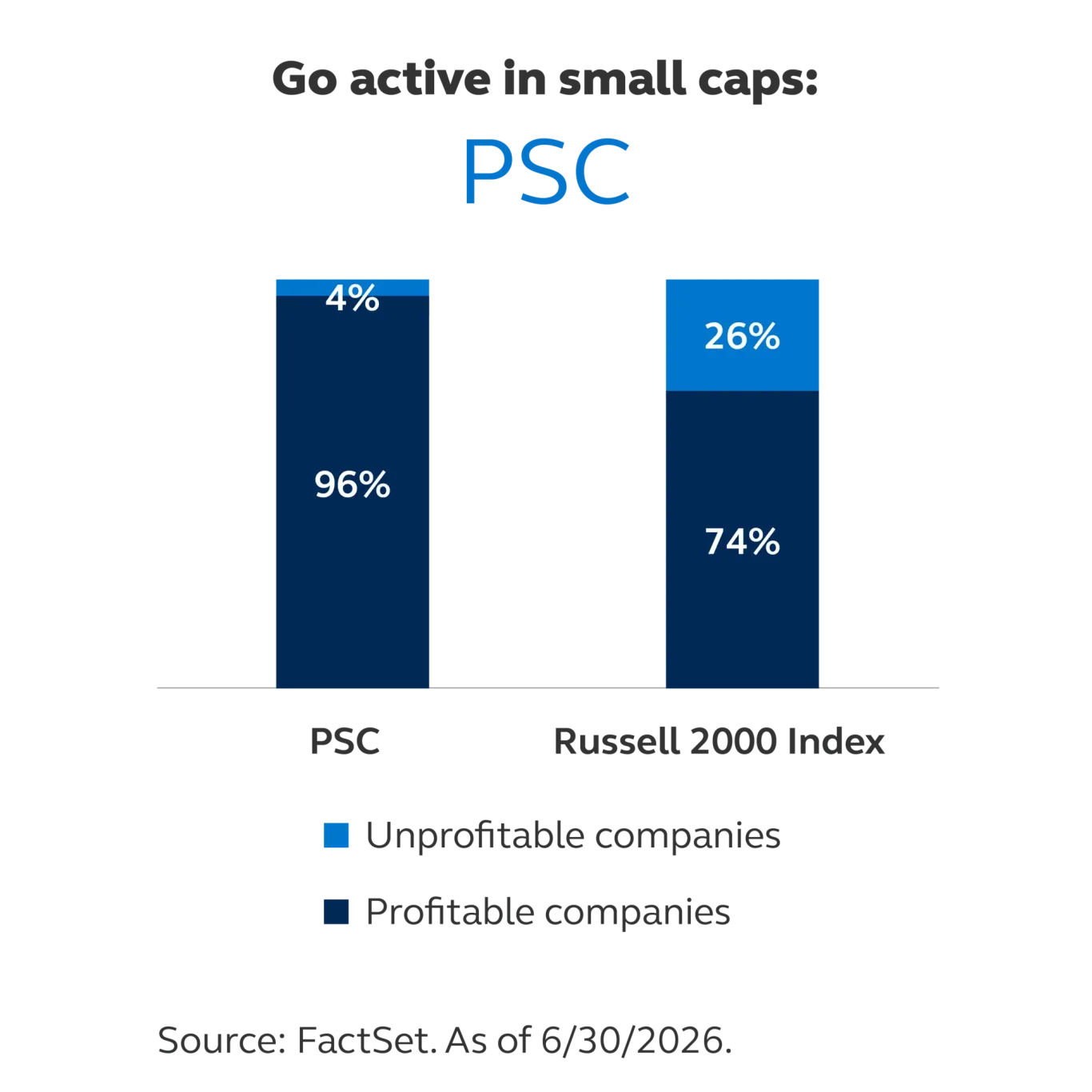
Small caps represent one of the top-performing asset classes this year, yet the Russell 2000 Index presents challenges: 26% of its companies are unprofitable, and many may lack the liquidity needed for efficient trading.
Consider using an active ETF, like PSC.
PSC uses a rules-based methodology to address index challenges by combining value, quality, and momentum characteristics—drawing on both growth and value styles.
Carefully consider a fund’s objectives, risks, charges, and expenses. For a prospectus, or summary prospectus if available, containing this and other information, visit PrincipalAM.com or call sales support at 800-787-1621. Please read it carefully before investing.
Principal Funds are distributed by Principal Funds Distributor, Inc. ALPS Distributors, Inc. is the distributor of the Principal ETFs. ALPS Distributors, Inc. and the Principal Funds are not affiliated.
Asset allocation and diversification do not ensure a profit or protect against a loss. Investing in ETFs involves risk, including possible loss of principal. ETFs are subject to risk similar to those of stocks, including those regarding short-selling and margin account maintenance. Investor shares are bought and sold at market price (not NAV) and are not individually redeemed from the Fund. Ordinary brokerage commissions apply.
Individual product risks:
Principal Active High Yield ETF:
Fixed income investment options are subject to interest rate risk, and their value will decline as interest rates rise. Neither the principal bond investment options nor their yields are guaranteed by the U.S. government. Lower-rated securities are subject to additional credit and default risk.
International and global investing involves greater risks such as currency fluctuations, political/social instability and differing accounting standards. Investing in derivates entails specific risks relating to liquidity, leverage and credit, which may reduce returns and/or increase volatility.
Principal U.S. Small Cap ETF Principal U.S. Mega-Cap ETF:
Equity investments involve greater risk, including heightened volatility, than fixed-income investments.
Small-cap stocks may have additional risks including greater price volatility.
Principal International Equity ETF:
International and global investing involves greater risks such as currency fluctuations, political/social instability and differing accounting standards. These risks are magnified in emerging markets. Small- and mid-cap stocks may have additional risks including greater price volatility.
© 2026 Principal Financial Services, Inc. Principal®, Principal Financial Group®, Principal Asset Management, and Principal and the logomark design are registered trademarks and service marks of Principal Financial Services, Inc., a Principal Financial Group company, in various countries around the world and may be used only with the permission of Principal Financial Services, Inc.
Principal Asset Management is a trade name of Principal Global Investors, LLC. Principal Global Investors leads global asset management at Principal®.
MM14376-06 | 07/2026 | 5765399-112026 | PRI002232-072027