


Principal Financial Group
Principal Asset Management
What can we help you find? Close
Enter ticker of search term
United states Principal Financial Group
Home Insights Macro views 3Q recap: Resilience is reshaping the outlook
Office building windows showing lobby stairs and two associates sitting on a bench inside
3Q recap: Resilience is reshaping the outlook

In the third quarter, markets absorbed higher rates, rising oil prices, and renewed inflation concerns, and continued to advance. Strong earnings, consumer spending, and sustained AI-related investment kept growth intact, although that CAPEX may also be reinforcing a higher-for-longer rate environment. The result for investors is a broader opportunity set, highlighted by improved income in bonds, continued support for risk assets, and a greater premium on selectivity.

Asset class performance

Total return, annual averages over period shown, 2011-June 2026
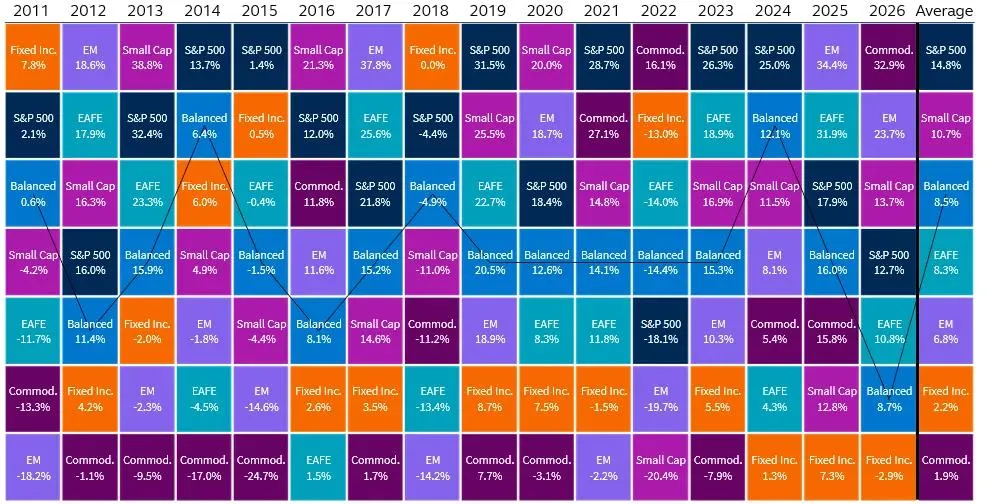
Color-coded heat map comparing annual returns across major asset classes from 2011 through September 2026. Leadership rotates si

Source: Clearnomics, Principal Asset Management. Asset classes are represented by the S&P 500, MSCI EM, MSCI EAFE, Russell 2000, iShares Core U.S. Bond Aggregate and Bloomberg Commodity Index. The Balanced Portfolio is a hypothetical 60/40 portfolio consisting of 40% U.S. Large Cap, 5% Small Cap, 10% International Developed Equities, 5% Emerging Market Equities, 35% U.S. Bonds, and 5% Commodities. Data as of September 30, 2026.

The third quarter gave investors plenty of reasons to be cautious, and markets continued to climb anyway. Despite a weak September, the third quarter saw the S&P 500 gain 2.3%, and the Nasdaq composite rise 2.8%, leaving both near record territory. Strong earnings, resilient growth, and continued investment in AI infrastructure helped offset higher rates and renewed inflation concerns. 

The quarter’s most notable moves were in energy and bonds. The Energy sector led the S&P 500 as conflict in the Middle East pushed oil prices toward $100/barrel. In fixed income, persistent inflation and steady economic activity drove 5-, 10-, and 30-year Treasury yields above 5% for the first time in roughly two decades.

Economic signals were mixed in 3Q but point to continued resilience. Consumer confidence fell to a 12-year low, yet second-quarter GDP growth was revised up to 2.2%, supported by consumer spending. And while inflation remains above the Fed’s target, AI-related capital investment is potentially adding a structural source of demand and reinforcing a higher-for-longer rate environment.

For investors, the quarter leaves a more balanced opportunity set. Higher yields have improved the income available in bonds, while strong earnings and continued AI-related investment remain supportive of equities. Together, those dynamics suggest an environment where resilience can persist, even as elevated rates and inflation continue to demand greater selectivity.

Disclosure

©2026 Principal Financial Services, Inc., 
711 High Street, Des Moines, Iowa 50392 

Investing involves risk, including possible loss of principal. Past Performance does not guarantee future return. All financial investments involve an element of risk. Fixed‐income investment options are subject to interest rate risk, and their value will decline as interest rates rise. Equity markets are subject to many factors, including economic conditions, government regulations, market sentiment, local and international political events, and environmental and technological issues that may impact return and volatility.  Equity stocks of small and mid-cap companies carry greater risks including that they may be more volatile and less liquid than equity stocks of larger, more established companies. International investing involves greater risks such as currency fluctuations, political/social instability, and differing accounting standards. Risk is magnified in emerging markets, which may lack established legal, political, business, or social structures to support securities markets.

Investing involves risk, including possible loss of principal. Past Performance does not guarantee future return. All financial investments involve an element of risk. AI companies face significant investment risks due to limited resources, intense competition, and rapid product obsolescence, making them particularly vulnerable to market volatility. International investing involves greater risks such as currency fluctuations, political/social instability, and differing accounting standards. Equity markets are subject to many factors, including economic conditions, government regulations, market sentiment, local and international political events, and environmental and technological issues that may impact return and volatility. Risk is magnified in emerging markets, which may lack established legal, political, business, or social structures to support securities markets. Investment in natural resource industries and commodity related derivatives can be affected by political/economic developments, market shocks/natural disasters, and other factors. 

Principal Asset Management leads global asset management at Principal.®

For Public Distribution in the U.S.  For Institutional, Professional, Qualified and/or Wholesale Investor Use only in other permitted jurisdictions as defined by local laws and regulations.

In Europe, this communication is directed exclusively at Professional Clients and Eligible Counterparties and should not be relied upon by Retail Clients. 

© 2026, Principal Financial Services, Inc. Principal Asset ManagementSM is a trade name of Principal Global Investors, LLC. Principal®, Principal Financial Group®, Principal Asset Management, and Principal and the logomark design are registered trademarks and service marks of Principal Financial Services, Inc., a Principal Financial Group company, in various countries around the world and may be used only with the permission of Principal Financial Services, Inc.

5982252