


At its September meeting, the Federal Open Market Committee (FOMC) increased the target range for the federal funds rate by 25 bps to 3.75%-4.00%, marking the Federal Reserve’s first rate hike in more than three years.
Today’s move was widely anticipated, given Federal Reserve Chair Kevin Warsh’s repeated comments that inflation's progress toward its target remains slow. Underpinned by a strengthening economy, a stable labor market, and an upward reassessment of inflationary risks in their updated projections, the unanimous decision this month suggests additional tightening may follow before year-end. Our base case calls for one more 25 bps rate hike in December.
During his post-meeting press conference, Chair Warsh provided a hawkish assessment of current conditions. He noted that since the last meeting in July, the overall economic environment has strengthened: domestic consumption has been resilient, investment activity has stayed robust, and the labor market has remained stable. Indeed, the underlying growth momentum has moved higher.
Against this backdrop, however, inflation has remained problematic, with underlying trends not yet showing any meaningful improvement. With this in mind, the decision to tighten policy was framed as “removing a dose of accommodation” that has helped support economic growth, while ensuring inflation returns to target in a timely fashion.
As expected, Chair Warsh provided no forward guidance, nor any characterization of what “timely” means. This suggests that the rate outlook will likely follow a path-dependent outcome based on how subsequent inflation data evolves from here.
The September SEP showed notable upward revisions across economic forecasts and the median policy path.
Growth: GDP growth was revised up from 2.2% to 2.3% for 2026, 2.3% to 2.4% for 2027, and was unchanged for 2028. The longer run growth rate was unchanged at 2.0%.
Labor market: The unemployment rate forecast was nudged down from 4.3% to 4.1% for 2026 and 2027, respectively, and revised down from 4.2% to 4.1% in 2028.
Inflation: Headline PCE inflation for 2026 was revised up from 3.6% to 3.7%, kept unchanged for 2027, and revised up from 2.0% to 2.1% for 2028. Core PCE was also raised from 3.3% to 3.4% for 2026, kept unchanged for 2027, and revised up from 2.1% to 2.2% for 2028. The 2% inflation target is not expected to be reached until 2029.
The median dot: The so-called “dot-plot” showed that 16 of the 18 FOMC participants expect additional tightening in 2026, with the median participant expecting at least one more 25 bps hike. The median participant no longer expects a rate cut in 2027, instead expecting rates to stay on hold. Fed Chair Warsh’s dot across all these periods remained absent. The upward revision to the long-run neutral rate also reinforces the message that higher-for-longer is no longer just a slogan, but an increasingly likely policy reality.
FOMC dot projections
September 2026
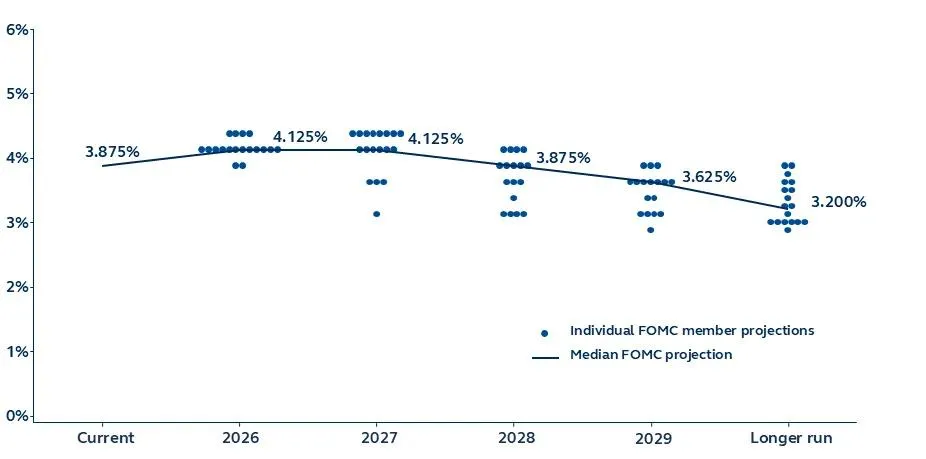
Source: Federal Reserve, Clearnomics, Principal Asset Management. Data as of September 16, 2026.
The Fed has begun its hiking cycle, and the debate now shifts from whether rates will rise again to how many hikes lie ahead. The unanimous vote makes a one-and-done move highly unlikely. With markets already pricing multiple increases, policymakers will probably need to deliver at least one more hike to safeguard credibility.
Absent any significant data surprises, an October hike remains unlikely given the upcoming U.S. midterm elections. Our base case calls for just one more rate hike in December, as we expect temporary inflation factors to fade and upcoming methodological changes to lower PCE inflation readings.
That said, with inflation not projected to return to target until 2029 under the Fed’s current path, the case for even more tightening remains compelling. If signs of second-round inflationary effects begin to materialize, or there is a renewed and significant escalation in the Iran war that further pushes up energy prices, then additional rate hikes are possible in 2027.
Investing involves risk, including possible loss of principal. Past performance is no guarantee of future results.
Views and opinions expressed are accurate as of the date of this communication and are subject to change without notice. This material may contain ‘forward-looking’ information that is not purely historical in nature and may include, among other things, projections and forecasts. There is no guarantee that any forecasts made will come to pass. Reliance upon information in this material is at the sole discretion of the reader.
The information in the article should not be construed as investment advice or a recommendation for the purchase or sale of any security. The general information it contains does not take account of any investor’s investment objectives, particular needs, or financial situation.
5934057

No information