


The 2024 U.S. election
Calls from senior members of the Democratic party finally became too great this past weekend, with President Biden bowing out of the 2024 U.S. Presidential race. He will not be seeking a second term.
The word from Washington D.C. the past few weeks, which became louder following the President’s much maligned debate performance in late June, was that a shakeup of the Democrat’s ticket may be coming. Now, with President announcing via social media on Sunday that he would be bowing out, and by endorsing Vice President Kamala Harris, it sets in motion a series of fairly unprecedented challenges facing Democrats ahead of their national convention, starting August 19 in Chicago.
Regardless of who faces off against former president Donald Trump in November, the U.S. political climate has rarely felt more polarized. With daily headlines highlighting concerns over inflation, persistent economic fears, and ongoing disputes in Washington regarding the budget, immigration, and foreign policy, it is also entirely natural for investors to worry about the lasting impact of politics on markets, the economy, and their portfolios.
Luckily however, we get to witness that impact on investing every four years in the United States. And since 1933, the S&P 500 has averaged double-digit gains, whether Democrats or Republicans occupy the White House. So, while the political unknowns faced between now and November 5 will undoubtably overwhelm, and the candidates will make galvanizing speeches touting the merits of their policies, and the flaws of their opponents, it's important for investors to stay focused on their long-term goals, and not get swayed by short-term political rhetoric.
What is the path forward for the Democrats?
Not since Lyndon Johnson in 1968 has an eligible incumbent president not advanced to represent their party for the general election.1 When then-president Johnson announced that he would not seek re-election, it was in late March of 1968 – a full 4 months earlier than President Biden just did. Needless to say, the timeline for the Democrats today to agree to a candidate and run a campaign is significantly compressed.
While Vice President Harris has received Biden’s endorsement and significant public support from convention delegates, she is not yet officially the party’s nominee. Here are the likely next steps for Democrats, and Harris, as outlined by AP Reports.
Lagging popularity, and an economy that surprisingly isn’t helping…
Heading into the weekend, former-president Trump was ahead of Biden in national polls and 7 key swing states according to RealClearPolitics average polling, up by 3.0 in the general election.
President Biden’s lagging popularity with voters was perhaps surprising. Typically, a strong economy benefits the incumbent, and the U.S. economic backdrop is very positive, defying recession expectations and outperforming most other major global economies. Real GDP grew over 3% last year, real disposable income growth has been strong, and the unemployment rate is just 4.1%. Yet, Biden was not benefitting from this strong macro environment. Instead, voters appeared more focused on two factors – languishing house price affordability and still elevated inflation – both likely amongst the most important “real world” economic issues that, as Fed Chair Powell often notes at FOMC meetings, “impact people from all walks of life, particularly lower income groups.”
Contribution to headline U.S. inflation
Year-over-year, January 2015-present
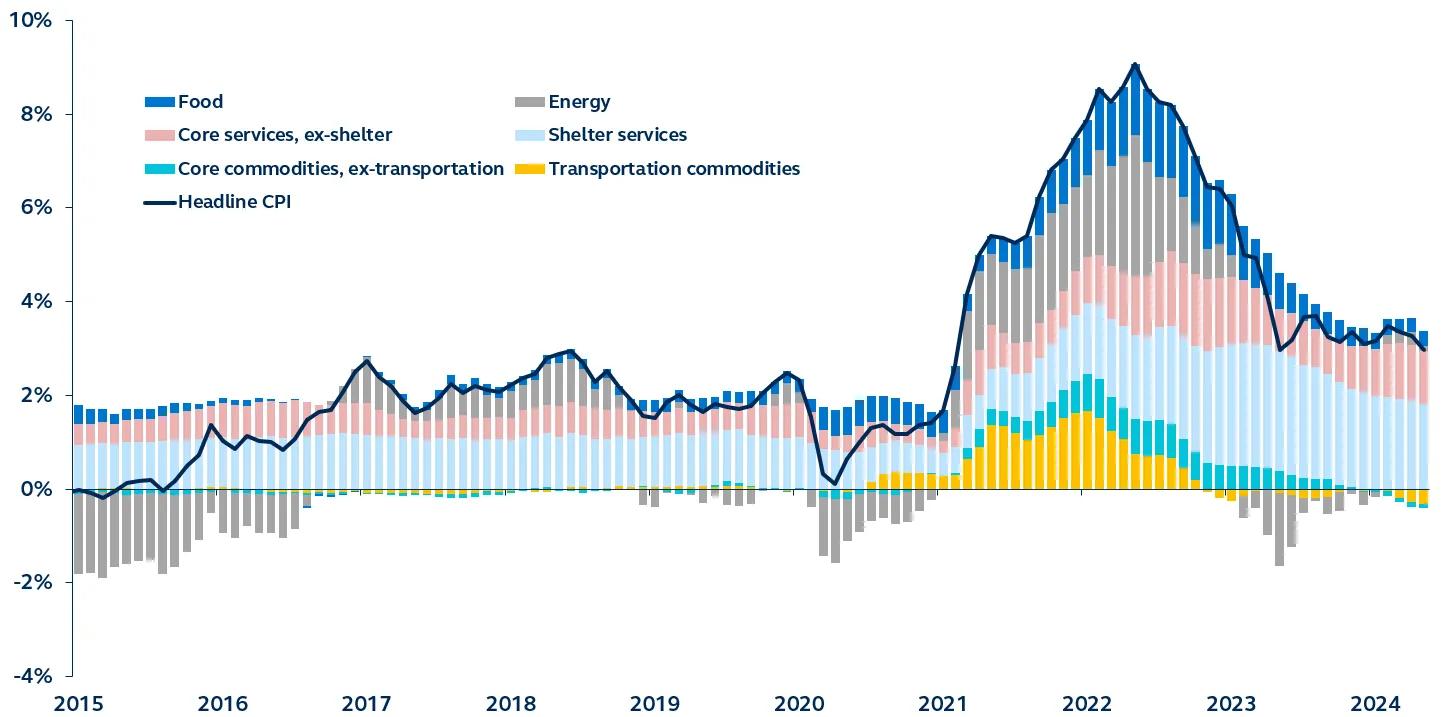
Despite a positive economic backdrop for corporates and markets, the economic malaise felt more directly by households goes some way to explaining Biden’s disappointing ranking in the polls. However, the exit of Biden from the race, and likely nomination of Harris, does not change the fact that the economy’s performance in the run-up to the election – specifically, inflation, interest rates and unemployment, will likely have a significant impact on voting behavior in November.
Perspectives approaching November for investors
The immediate fallout from President Biden’s announcement to not seek re-election has had little to no impact on markets. Similarly, Democrat’s choice to nominate Harris, or any other candidate to face-off against Trump in November will likely be the same. So, despite the headlines, markets are telling investors that it is the policies on things like trade, regulation, energy and taxes that need to remain in focus.
Trump’s policies and positions have broadly been already digested by markets. Equally, it is likely that whomever the Democrats nominate will have similar agenda to the one that President Biden had been campaigning on. Therefore, in an economic environment where the policies – not the candidates – should be the focus, the political transition, though significant, is less likely to cause immediate market turbulence compared to the specific policy directions that follow.
For Public Distribution in the U.S. For Institutional, Professional, Qualified and/or Wholesale Investor Use Only in other Permitted Jurisdictions as defined by local laws and regulations.
Risk Considerations
Investing involves risk, including possible loss of principal. Past performance is no guarantee of future results and should not be relied upon to make an investment decision. Inflation and other economic cycles and conditions are difficult to predict and there Is no guarantee that any inflation mitigation strategy will be successful.
Important information
This material covers general information only and does not take account of any investor’s investment objectives or financial situation and should not be construed as specific investment advice, a recommendation, or be relied on in any way as a guarantee, promise, forecast or prediction of future events regarding an investment or the markets in general. The opinions and predictions expressed are subject to change without prior notice. The information presented has been derived from sources believed to be accurate; however, we do not independently verify or guarantee its accuracy or validity. Any reference to a specific investment or security does not constitute a recommendation to buy, sell, or hold such investment or security, nor an indication that the investment manager or its affiliates has recommended a specific security for any client account.
All figures shown in this document are in U.S. dollars unless otherwise noted.
This material may contain ‘forward looking’ information that is not purely historical in nature. Such information may include, among other things, projections and forecasts. There is no guarantee that any forecasts made will come to pass. Reliance upon information in this material is at the sole discretion of the reader. This material is not intended for distribution to or use by any person or entity in any jurisdiction or country where such distribution or use would be contrary to local law or regulation.
This document is issued in:
- The United States by Principal Global Investors, LLC, which is regulated by the U.S. Securities and Exchange Commission.
- Europe by Principal Global Investors (Ireland) Limited, 70 Sir John Rogerson’s Quay, Dublin 2, D02 R296, Ireland. Principal Global Investors (Ireland) Limited is regulated by the Central Bank of Ireland. Clients that do not directly contract with Principal Global Investors (Europe) Limited (“PGIE”) or Principal Global Investors (Ireland) Limited (“PGII”) will not benefit from the protections offered by the rules and regulations of the Financial Conduct Authority or the Central Bank of Ireland, including those enacted under MiFID II. Further, where clients do contract with PGIE or PGII, PGIE or PGII may delegate management authority to affiliates that are not authorised and regulated within Europe and in any such case, the client may not benefit from all protections offered by the rules and regulations of the Financial Conduct Authority, or the Central Bank of Ireland. In Europe, this document is directed exclusively at Professional Clients and Eligible Counterparties and should not be relied upon by Retail Clients (all as defined by the MiFID).
- United Kingdom by Principal Global Investors (Europe) Limited, Level 1, 1 Wood Street, London, EC2V 7 JB, registered in England, No. 03819986, which is authorized and regulated by the Financial Conduct Authority (“FCA”).
- United Arab Emirates by Principal Global Investors LLC, a branch registered in the Dubai International Financial Centre and authorized by the Dubai Financial Services Authority as a representative office and is delivered on an individual basis to the recipient and should not be passed on or otherwise distributed by the recipient to any other person or organisation.
- Singapore by Principal Global Investors (Singapore) Limited (ACRA Reg. No. 199603735H), which is regulated by the Monetary Authority of Singapore and is directed exclusively at institutional investors as defined by the Securities and Futures Act 2001. This advertisement or publication has not been reviewed by the Monetary Authority of Singapore.
- Australia by Principal Global Investors (Australia) Limited (ABN 45 102 488 068, AFS Licence No. 225385), which is regulated by the Australian Securities and Investments Commission and is only directed at wholesale clients as defined under Corporations Act 2001.
- This document is marketing material and is issued in Switzerland by Principal Global Investors (Switzerland) GmbH.
- Hong Kong SAR (China) by Principal Asset Management Company (Asia) Limited, which is regulated by the Securities and Futures Commission. This document has not been reviewed by the Securities and Futures Commission.
- Other APAC Countries/Jurisdictions, this material is issued for institutional investors only (or professional/sophisticated/qualified investors, as such term may apply in local jurisdictions) and is delivered on an individual basis to the recipient and should not be passed on, used by any person or entity in any jurisdiction or country where such distribution or use would be contrary to local law or regulation.
Principal Funds are distributed by Principal Funds Distributor, Inc.
© 2024 Principal Financial Services, Inc. Principal®, Principal Financial Group®, Principal Asset Management, and Principal and the logomark design are registered trademarks and service marks of Principal Financial Services, Inc., a Principal Financial Group company, in various countries around the world and may be used only with the permission of Principal Financial Services, Inc. Principal Asset Management℠ is a trade name of Principal Global Investors, LLC.
3736308

No information