

AI becomes the dominant global growth engine
The world economy has proved remarkably resilient to geopolitical shocks as the AI capex cycle has evolved into the dominant force driving global growth. While the benefits are global, they remain unevenly distributed.
U.S. economic resilience shifts the risk from slowdown to overheating
The U.S. economy has again surprised to the upside. Consumer spending remains robust, job growth has broadened, and AI-led investment continues to underpin activity, but this strength risks eventually reigniting inflation pressures.
The global central bank easing cycle is over
Although inflation risks have moderated, they have not disappeared. Central banks around the globe are increasingly debating rate hikes. We expect the Fed to remain on hold, but policy risks remain skewed toward hawkish outcomes.
Extending the equity market bull run
Technology continues to lead global equity markets, but broadening earnings growth and easing geopolitical risks are creating opportunities beyond hyperscalers and semiconductors. Elevated valuations and policy tightening bias imply measured gains ahead.
Tight fixed income spreads leave little margin for error
With a prolonged period of central bank policy restraint approaching, income remains the most attractive component of returns. With tight spreads leaving little margin for error, disciplined selectivity will be key.
Diversify to access the multiple layers of structural growth
The AI boom is rewarding economies, sectors, and companies with the capital, talent, energy security, and technological leadership needed to support it. The result is a new form of exceptionalism, centered on the U.S. but extending across the global AI ecosystem. For investors, diversification is about accessing these multiple sources of structural growth.
Resilient global growth, renewed inflation pressures
Key takeaway
The global economy has held up well but is facing a renewed inflation shock, prompting hawkish central bank reactions. The global monetary easing cycle is over.
Once again, the global economy has absorbed a significant shock with limited damage, entering the second half of the year on a firmer footing than many had feared. Growth forecasts have been revised lower across many economies, but global recession risks have receded materially. Even after these downgrades, the U.S. is still expected to grow at around its long-run trend rate of 2.1%, while China’s outlook has been broadly stable. Global activity has slowed, but from a position of underlying resilience.
By contrast, the energy shock, coupled with the persistence of underlying price pressures, has driven a more challenging inflation outlook. Consensus expectations for 2026 point to a renewed and material upward revision in inflation, particularly across energy-importing economies such as Europe. That said, there are early signs of moderation. The de-escalation in U.S.–Iran tensions has contributed to a sharp fall in oil prices, with forward curves pointing to significantly lower levels by year-end. Inflation forecasts may soon be revised slightly lower.
Central banks have responded with a more cautious, hawkish stance, signaling that the global easing cycle is ending. In this environment, the AI-driven capex cycle should play an increasingly important role in sustaining growth.
U.S. macro strength bolstered by investment
Key takeaway
The economy’s surprising resilience amid headwinds is underscored by a strong capex cycle and robust consumer spending.
Despite geopolitical uncertainty and persistent concerns about inflation, the U.S. economy has remained remarkably resilient. Activity data continue to paint a constructive picture, with manufacturing rebounding, capital spending strengthening, retail sales holding up, and job growth stabilizing. The biggest disconnect remains confidence, as consumer and small business surveys continue to reflect caution and concerns about higher prices – the recent drop in energy prices should drive an improvement in confidence over the coming months.
Underneath the surface, growth is being supported by two pillars: healthy consumer spending and a powerful investment cycle. Indeed, while the consumer remains the backbone of the economy, AI-related investment, data center construction, and broader infrastructure spending have emerged as increasingly important drivers of growth, helping to offset cyclical softness and buffer the economy against downside risks.
The U.S. remains exposed to the dynamics of the tech and infrastructure cycle, but it is also well positioned to benefit as broader productivity gains from this investment phase begin to materialize.
A Fed pause—but hikes more likely than cuts
Key takeaway
Fed policy is likely to remain on hold through 2026, but with a tightening bias as inflation caution dominates. Markets expect tightening across major global central banks.
Although inflation forecasts have moved higher in recent months, forward-looking risks appear more balanced. The U.S.–Iran agreement and the resulting decline in energy prices increase the likelihood that energy-driven inflation peaks sooner and at lower levels than previously feared. Against this backdrop, and with policy uncertainty elevated—particularly amid a broad internal review of the Fed’s framework and reaction function under new Chair Kevin Warsh—holding rates steady through year-end remains our base case.
That said, risks remain skewed towards tightening. A combination of sustained economic strength, a renewed rise in core inflation, and signs that inflation expectations are becoming less well anchored would materially raise the probability of rate hikes. The latest Fed dot plot underscores this bias, with 9 of 18 participants projecting at least one hike this year, leaving the policy outlook finely balanced.
Globally, central banks have also turned more cautious. Markets price around 50 basis points of Fed tightening by early 2027, alongside further increases from the ECB and the Bank of Japan. In the UK, expectations for easing have been fully unwound. The global easing cycle has run its course.
U.S. equities: rotating beyond the usual tech winners
Key takeaway
While AI-related euphoria persists, easing geopolitical tensions are improving the cyclical outlook and broadening the opportunity set to segments that have been under pressure.
Equity markets have climbed the geopolitical wall of worry with remarkable ease, supported by exceptionally strong earnings growth. Most major equity indices reached record highs even before U.S.-Iran tensions began to ease, with continued AI investment by U.S. hyperscalers reinforcing strength across the broader AI ecosystem.
While tech has been the clear standout performer, earnings momentum is broadening across sectors, supported by strong corporate profitability and a resilient macro backdrop. Easing geopolitical tensions are helping revive areas hit hardest by the energy shock. At the same time, wider AI adoption is creating opportunities beyond the hyperscalers and semiconductor companies that have led the market, particularly in sectors positioned to capture productivity gains and supported by durable structural tailwinds. A mini-rotation appears to be underway.
The key risks remain Fed policy and valuations. Higher rates have historically challenged equity markets, and elevated multiples increase the market's vulnerability to earnings or growth disappointments. However, provided earnings remain strong and growth resilient, any policy tightening is more likely to moderate returns than derail the bull market.
Cyclical and structural factors keep U.S. yields elevated
Key takeaway
Bond yields have been moving steadily higher, though pressures have been more pronounced at the short end, leading to an overall flattening of the yield curve.
Optimism surrounding the Middle East conflict has led to a reassessment of inflation risks across global bond markets, alleviating upward pressure on yields. Yet, bifurcation remains as idiosyncratic factors have come back into focus.
The decline in energy prices has weighed significantly on forward inflation measures across major economies, erasing most of the increase since the start of the conflict.
While this led to a decline in global bond yields, particularly across parts of the euro area, U.S. borrowing costs remain broadly elevated on a year-to-date basis. Indeed, the U.S. 10-year yield is still up about 20 bps since the start of the year, hovering around 4.4% at the end of Q2.
A combination of cyclical and structural factors has contributed to this dynamic. Driven by a surprisingly resilient growth backdrop and an improving labor market, increased expectations of Fed rate hikes have pushed short-term interest rates higher. Meanwhile, structural factors, including a challenged fiscal backdrop and lingering geopolitical instability, have all kept risk premiums elevated for long-term rates. Looking ahead, the end of the global easing cycle, coupled with global fiscal concerns, is likely to prevent government bond yields from declining much further.
The AI investment cycle brings a new exceptionalism
Key takeaway
Diversification is no longer just about reducing risk; it is about accessing multiple sources of structural growth and resilience.
Geopolitical tensions and persistent inflation have challenged the global outlook, yet the world economy continues to defy expectations. Driving much of this resilience is the AI investment cycle, which has become one of the largest infrastructure build-outs in modern history. What began as a technology story is now supporting growth across manufacturing, energy, industrials, and global supply chains, creating a new form of exceptionalism centered on the U.S. but increasingly global in scope.
Even so, the investment backdrop is becoming more complex. The global easing cycle has largely run its course, with central banks increasingly focused on inflation risks and the limits of policy support. As monetary tailwinds fade, market performance is likely to depend more on earnings growth, productivity gains, and structural investment trends.
For investors, diversification remains essential, not simply as a tool for risk management, but as a way to capture opportunities across multiple sources of growth. We continue to favor beneficiaries of the AI investment cycle across equities and real assets, while also identifying opportunities as earnings growth broadens across sectors and regions. In fixed income, elevated yields support an emphasis on income, while a strong U.S. dollar remains an important source of portfolio resilience.
Asset class performance
Total return, annual averages over period shown, 2011-June 2026
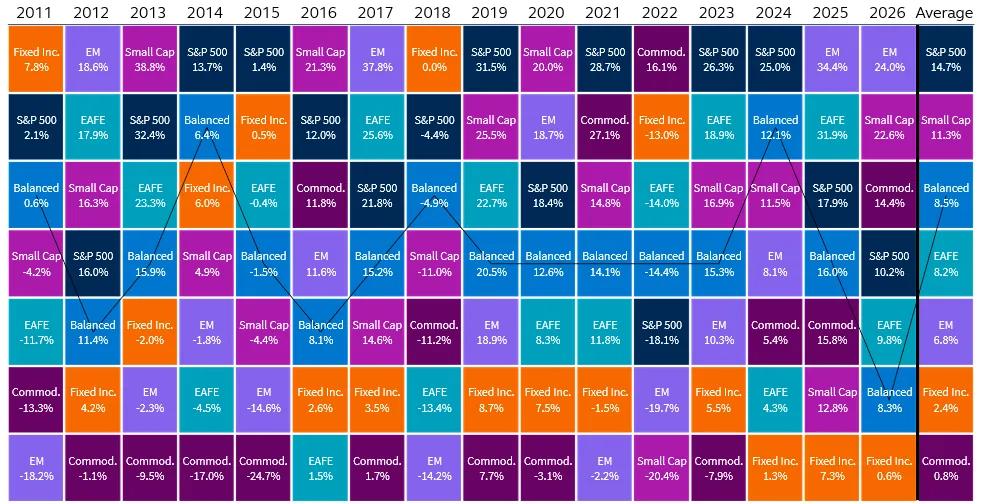
Source: Clearnomics, Principal Asset Management. Asset classes are represented by the S&P 500, MSCI EM, MSCI EAFE, Russell 2000, iShares Core U.S. Bond Aggregate and Bloomberg Commodity Index. The Balanced Portfolio is a hypothetical 60/40 portfolio consisting of 40% U.S. Large Cap, 5% Small Cap, 10% International Developed Equities, 5% Emerging Market Equities, 35% U.S. Bonds, and 5% Commodities. Data as of June 30, 2026.
Principal Global Insights team
Chief Global Strategist
Sr. Director, Global Insights & Content Strategy
Market Strategist
Sr. Insights Strategist
Market Strategist
Insights Strategist
Learn more about the factors impacting markets and portfolios in the quarter ahead by downloading the full PDF.
Bloomberg U.S. High-Yield Corporate Bond Index is a rules-based, market-value-weighted index engineered to measure publicly issued non-investment grade USD fixed-rate, taxable and corporate bonds.
Bloomberg U.S. Corp High Yield 2% Issuer Capped Index is an unmanaged index comprised of fixed rate, non-investment grade debt securities that are dollar denominated. The index limits the maximum exposure to any one issuer to 2%.
Bloomberg U.S. Corporate Investment Grade Index includes publicly issued U.S. corporate and specified foreign debentures and secured notes that meet the specified maturity, liquidity and quality requirements. To qualify, bonds must be SEC-registered. The corporate sectors are industrial, utility and finance, which include both U.S. and non-U.S. corporations.
Bloomberg U.S. Treasury Index measures U.S. dollar-denominated, fixed-rate, nominal debt issued by the U.S. Treasury. Treasury bills are excluded by the maturity constraint. STRIPS are excluded from the index because their inclusion would result in double-counting.
MSCI ACWI Index includes large and mid cap stocks across developed and emerging market countries.
MSCI Brazil Index is designed to measure the performance of the large and mid cap segments of the Brazilian market.
MSCI China Index captures large and mid cap representation across China A shares, H shares, B shares, Red chips, P chips and foreign listings (e.g. ADRs).
MSCI EAFE Index is listed for foreign stock funds (EAFE refers to Europe, Australasia, and Far East). Widely accepted as a benchmark for international stock performance, the EAFE Index is an aggregate of 21 individual country indexes.
MSCI Emerging Markets Index consists of large and mid cap companies across 24 countries and represents 10% of the world market capitalization. The index covers approximately 85% of the free float-adjusted market capitalization in each country in each of the 24 countries.
MSCI Europe Index captures large and mid cap representation across 15 Developed Markets (DM) countries in Europe.
MSCI Europe Banks Index is composed of large and mid cap stocks across 15 Developed Markets countries in Europe. All securities in the index are classified in the Banks industry group (within the Financials sector) according to the Global Industry Classification Standard (GICS®).
MSCI Germany Index is designed to measure the performance of the large and mid cap segments of the German market.
MSCI India Index is designed to measure the performance of the large and mid cap segments of the Indian market.
MSCI Japan Index is designed to measure the performance of the large and mid cap segments of the Japanese market.
MSCI United Kingdom Index is designed to measure the performance of the large and mid cap segments of the UK market.
MSCI USA Growth Index captures large and mid cap securities exhibiting overall growth style characteristics in the U.S. The growth investment style characteristics for index construction are defined using five variables: long-term forward EPS growth rate, short-term forward EPS growth rate, current internal growth rate and long-term historical EPS growth trend and long-term historical sales per share growth trend.
MSCI USA Index is a market capitalization weighted index designed to measure the performance of equity securities in the top 85% by market capitalization of equity securities listed on stock exchanges in the United States.
MSCI USA Large Cap Index is designed to measure the performance of the large cap segments of the U.S. market.
MSCI USA Mid Cap Index is designed to measure the performance of the mid cap segments of the U.S. market.
MSCI USA Quality Index aims to capture the performance of quality growth stocks by identifying stocks with high quality scores based on three main fundamental variables: high return on equity (ROE), stable year-over-year earnings growth and low financial leverage. The MSCI Quality Indexes complement existing MSCI Factor Indexes and can provide an effective diversification role in a portfolio of factor strategies.
MSCI USA Small Cap Index is designed to measure the performance of the small cap segment of the U.S. equity market.
MSCI USA Value Index captures large and mid cap U.S. securities exhibiting overall value style characteristics. The value investment style characteristics for index construction are defined using three variables: book value to price, 12-month forward earnings to price and dividend yield.
Standard & Poor’s 500 Index is a market capitalization-weighted index of 500 widely held stocks often used as a proxy for the stock market.
U.S. dollar index (USDX) is a measure of the value of the U.S. dollar relative to a basket of foreign currencies.
Market indices have been provided for comparison purposes only. They are unmanaged and do not reflect any fees or expenses. Individuals cannot invest directly in an index.
Risk considerations
Investing involves risk, including possible loss of principal. Past performance is no guarantee of future results. Equity investments involve greater risk, including higher volatility, than fixed-income investments. Fixed-income investments are subject to interest rate risk; as interest rates rise their value will decline. International and global investing involves greater risks such as currency fluctuations, political/social instability and differing accounting standards. Investors should be aware that alternative investments including private equity and private debt are speculative, subject to substantial risks including the risks associated with limited liquidity, the use of leverage, short sales and concentrated investments and may involve complex tax structures and investment strategies. Alternative investments may be illiquid, there may be no liquid secondary market or ready purchasers for such securities, and they may be subject to high fees and expenses, which will reduce profits. Alternative investments are not appropriate for all investors and should not constitute an entire investment program. Asset allocation and diversification do not ensure a profit or protect against a loss.
Important information
This material covers general information only and does not take account of any investor’s investment objectives or financial situation and should not be construed as specific investment advice, a recommendation, or be relied on in any way as a guarantee, promise, forecast or prediction of future events regarding an investment or the markets in general. Information presented has been derived from sources believed to be accurate; however, we do not independently verify or guarantee its accuracy or validity. Any reference to a specific investment or security does not constitute a recommendation to buy, sell, or hold such investment or security, nor an indication that the investment manager or its affiliates has recommended a specific security for any client account. Subject to any contrary provisions of applicable law, the investment manager and its affiliates, and their officers, directors, employees, agents, disclaim any express or implied warranty of reliability or accuracy and any responsibility arising in any way (including by reason of negligence) for errors or omissions in the information or data provided.
This material may contain ‘forward‐looking’ information that is not purely historical in nature and may include, among other things, projections, and forecasts. There is no guarantee that any forecasts made will come to pass. Reliance upon information in this material is at the sole discretion of the reader.
This material is not intended for distribution to or use by any person or entity in any jurisdiction or country where such distribution or use would be contrary to local law or regulation.
This document is intended for use in:
- The United States by Principal Global Investors, LLC, which is regulated by the U.S. Securities and Exchange Commission.
- Europe by Principal Global Investors (Ireland) Limited, 70 Sir John Rogerson’s Quay, Dublin 2, D02 R296, Ireland. Principal Global Investors (Ireland) Limited is regulated by the Central Bank of Ireland. Clients that do not directly contract with Principal Global Investors (Europe) Limited (“PGIE”) or Principal Global Investors (Ireland) Limited (“PGII”) will not benefit from the protections offered by the rules and regulations of the Financial Conduct Authority or the Central Bank of Ireland, including those enacted under MiFID II. Further, where clients do contract with PGIE or PGII, PGIE or PGII may delegate management authority to affiliates that are not authorized and regulated within Europe and in any such case, the client may not benefit from all protections offered by the rules and regulations of the Financial Conduct Authority, or the Central Bank of Ireland. In Europe, this document is directed exclusively at Professional Clients and Eligible Counterparties and should not be relied upon by Retail Clients (all as defined by the MiFID).
- United Kingdom by Principal Global Investors (Europe) Limited, Level 1, 1 Wood Street, London, EC2V 7 JB, registered in England, No. 03819986, which is authorized and regulated by the Financial Conduct Authority (“FCA”).
- This document is marketing material and is issued in Switzerland by Principal Global Investors (Switzerland) GmbH.
- United Arab Emirates by Principal Investor Management (DIFC) Limited, an entity registered in the Dubai International Financial Centre and authorized by the Dubai Financial Services Authority as an Authorised Firm, in its capacity as distributor / promoter of the products and services of Principal Asset Management. This document is delivered on an individual basis to the recipient and should not be passed on or otherwise distributed by the recipient to any other person or organisation.
- Singapore by Principal Global Investors (Singapore) Limited (ACRA Reg. No.199603735H), which is regulated by the Monetary Authority of Singapore and is directed exclusively at institutional investors as defined by the Securities and Futures Act 2001. This advertisement or publication has not been reviewed by the Monetary Authority of Singapore.
- Australia by Principal Global Investors (Australia) Limited (ABN 45 102 488 068, AFS Licence No. 225385), which is regulated by the Australian Securities and Investments Commission and is only directed at wholesale clients as defined under Corporations Act 2001.
- Hong Kong SAR by Principal Asset Management Company (Asia) Limited, which is regulated by the Securities and Futures Commission. This document has not been reviewed by the Securities and Futures Commission. This document may only be distributed, circulated or issued to persons who are Professional Investors under the Securities and Futures Ordinance and any rules made under that Ordinance or as otherwise permitted by that Ordinance.
- Other APAC Countries/Jurisdictions. This material is issued for Institutional Investors only (or professional/sophisticated/qualified investors, as such term may apply in local jurisdictions) and is delivered on an individual basis to the recipient and should not be passed on, used by any person or entity in any jurisdiction or country where such distribution or use would be contrary to local law or regulation.
- Nothing in this document is, and shall not be considered as, an offer of financial products or services in Brazil. This presentation has been prepared for informational purposes only and is intended only for the designated recipients hereof. Principal Global Investors is not a Brazilian financial institution and is not licensed to and does not operate as a financial institution in Brazil. This document is intended for use in Brazil by Principal Asset Management Ltda., a Brazilian asset manager licensed and authorized to carry out its activities in Brazil according to Declaratory Act n. 9.408/07. This document is delivered on an individual basis to the recipient and should not be passed on or otherwise distributed by the recipient to any other person or organisation.
- Principal Global Investors is not acting as agent for, or in conjunction with any Principal Financial Group affiliate domiciled in Mexico. By accepting this Presentation, the recipient confirms that is an Institutional and/or Accredited Investors pursuant to Articles 2 Sections XVI, XVII and 8 of the Mexican Securities Market Law (“LMV”). In case of not complying with the requirements established in the LMV, the recipient must notify it immediately, since the recipient has not the right to receive the information in order to comply with the LMV.
- The exhibition of this material in Chile does not constitute an offer for the purchase or sale of any local or foreign security, nor does it pretend to promote or advertise determinate securities or its issuers or facilitate the purchase or sale of determinate securities. This material has been prepared exclusively to be used in one on one presentation with institutional or qualified investors, capable of properly evaluating the limitations and risks involved in investment decisions. This presentation should not be provided to anyone else.
Principal Global Investors, LLC (PGI) is registered with the U.S. Commodity Futures Trading Commission (CFTC) as a commodity trading advisor (CTA), a commodity pool operator (CPO) and is a member of the National Futures Association (NFA). PGI advises qualified eligible persons (QEPs) under CFTC Regulation 4.7.
Principal Asset Management℠ is a trade name of Principal Global Investors, LLC.
Insurance products and plan administrative services provided through Principal Life Insurance Co. Principal Funds, Inc. is distributed by Principal Funds Distributor, Inc. Securities are offered through Principal Securities, Inc., +1-800‐547‐7754, Member SIPC and/or independent broker/dealers. Principal Life, Principal Funds Distributor, Inc., and Principal Securities are members of the Principal Financial Group®, Des Moines, IA 50392.
© 2026 Principal Financial Services, Inc. Principal®, Principal Financial Group®, Principal Asset Management, and Principal and the logomark design are registered trademarks and service marks of Principal Financial Services, Inc., a Principal Financial Group company, in various countries around the world and may be used only with the permission of Principal Financial Services, Inc.
5568126