

Solid foundations for global growth in 2026
The global economy enters 2026 on a firm footing, supported by widespread fiscal stimulus, monetary normalization, and accelerating AI-driven capex and adoption—factors that should underpin robust growth across most regions.
The U.S. economy has sustained its robust underlying architecture
Corporate profit margins are holding firm, and gains in household wealth are sustaining consumer spending despite labor market weakness. AI capex is a key engine of growth, while the OBBBA could fuel a prolonged investment impulse.
The Federal Reserve is approaching neutral as it balances inflation and employment concerns
Persistent inflation concerns, coupled with robust economic activity, imply only modest policy action. We expect two cuts in 2026, bringing rates just below the midpoint of the neutral range.
Equity market returns will be dependent on strong earnings growth
Stretched U.S. valuations and intensifying AI scrutiny imply that earnings—both in tech and beyond—must deliver. The solid macro backdrop is supportive of modest gains, with U.S. tech exposure, along with broader sectoral and regional diversification, offering upside while mitigating concentration risk.
Fixed income credit: Tight spreads but benefiting from robust macro tailwinds
Favorable macro conditions imply reduced default risk. Credit spreads remain very tight, but renewed private market stress—provided they are idiosyncratic rather than systemic in nature—may provide entry points.
Focus on balance and diversification
2025 delivered the strongest cross-asset and cross-regional performances in recent years. The solid macro backdrop for 2026 argues for a continued focus on diversification, particularly in light of both AI risks and opportunities.
Global growth resilience amid U.S. policy upheaval
Key takeaway
Decisive policy responses helped offset the growth threat posed by U.S. import tariffs and should continue to support global growth in 2026.
Last year’s policy upheavals tested the resilience of the global economy in ways few anticipated. Yet, despite trade uncertainty, inflation concerns, and geopolitical fractures, global growth proved remarkably durable.
In the U.S., GDP growth in 2025 is likely to have come in only slightly below the consensus forecast at the start of the year—a notable improvement from the recession fears that gripped markets after Liberation Day. For Europe and China, growth appears to have exceeded early expectations.
This resilience reflects several factors. U.S. import tariffs turned out lower than initially feared, limiting their drag on global and U.S. growth. More importantly, policy responses were decisive. In Europe, a pivot towards expansionary fiscal policy—particularly in Germany—combined with swift ECB rate cuts to lift growth beyond early-year projections. In China, the “anti-involution” policy drive, aimed at reversing deflationary pressures, provided a boost in the first half of the year, even as domestic demand softened later. Meanwhile, a rerouting of trade flows from the U.S. to Asia and Europe helped sustain export momentum as a key growth engine.
These dynamics should underpin activity in 2026, setting the stage for a broadly constructive outlook for global growth.
U.S. economic strength defies market anxiety
Key takeaway
Despite depressed consumer confidence, the U.S. economy continues to perform well. Alongside consumer spending, AI capex has become an important anchor of the U.S. economy.
Although economic activity has remained robust, with GDP expanding by 4.3% in the third quarter, an undercurrent of concern persists. Consumer confidence is near record lows, even as retail sales remain resilient despite slowing job gains and pressure on household purchasing power from tariffs.
In contrast, business sentiment—among both small and large firms—has largely rebounded since Liberation Day, likely driven by this year’s surge in capital expenditure.
Beyond consumer spending, AI-related investment has emerged as an additional pillar of U.S. growth. Technology companies are accelerating their investment in AI infrastructure to secure a leadership position in the AI-driven revolution, which is expected to unlock new revenue streams and enhance profitability.
In the first three quarters of 2025, AI-related capital expenditure accounted for roughly 40% of GDP growth—slightly less when accounting for imported equipment. Even so, this represents a significant structural shift in the U.S. economy. With projections indicating AI-related capex could reach $1.3 trillion over the next five years, and providing the market narrative around AI does not take a turn for the worse, AI capex will likely have an expanding footprint in economic activity, remaining a key driver of U.S. growth.
Federal Reserve: Cautiously approaching neutral
Key takeaway
We expect two Fed cuts in 2026, taking rates close to neutral. Timing will be data-dependent, but a rising unemployment rate could prompt the cuts to be brought forward into the first half of the year.
The Fed has already delivered 150 basis points of easing in the current cutting cycle. With inflation sticky but not accelerating, the labor market cooling without collapsing, and fiscal stimulus set to support growth in early 2026, policy rates likely need to return to neutral—but not below.
The key question is: what constitutes neutral? Estimates vary widely. Some FOMC members argue rates are already at neutral, while others believe another 125 basis points of cuts are needed. What is clear is that, given the current strength of the U.S. economy—with Q3 2025 growth nearly twice its trend pace—there is no urgency to lower rates aggressively.
With a leadership change approaching, the Fed is likely to place slightly more emphasis on the employment side of its dual mandate. We anticipate two cuts in 2026—more than the single cut implied by the latest FOMC dot plot—which should bring rates just below the midpoint of the neutral range. The timing will remain data-dependent, but a continued rise in unemployment could prompt these cuts to be brought forward into the first half of the year.
Ultimately, the Fed’s challenge in 2026 will be calibrating policy in an environment where structural forces, rather than cyclical dynamics, increasingly shape growth and inflation.
U.S. equities: Supported by macro, AI, and a broader rally
Key takeaway
Despite AI uncertainty, the combination of policy support and a non-recessionary rate-cutting cycle points to a favorable macro backdrop in 2026, benefiting sectors beyond tech.
The S&P 500 delivered another year of double-digit gains in 2025, notching 39 record highs; however, it trailed the 20% returns of the prior two years. Meanwhile, Europe, the UK, Japan, China, and the broader EM outpaced the U.S., signalling cracks in U.S. exceptionalism. Momentum faded in Q4 as concerns over the vast sums of debt raised by leading tech firms for AI-driven capex triggered valuation worries and fears of spillover effects across the economy.
This does not suggest an imminent U.S. market pullback. Still, with scrutiny intensifying around the AI narrative, earnings in tech and beyond must meet heightened expectations.
Looking to 2026, the earnings outlook remains constructive. The U.S. macro backdrop is supportive, with fiscal and monetary policy poised to provide stimulus. Historically, a non-recessionary Fed cutting cycle has been positive for risk assets, while fiscal measures should add momentum—provided they do not spark a significant rise in bond yields.
This environment underpins continued upside for technology but also sets the stage for a broader rally across sectors such as financials and consumer discretionary. AI beneficiaries are likely to expand beyond the initial hyperscalers to a wider base of adopters, paving the way for healthier and more diversified U.S. equity market performance in 2026.
A benign backdrop for corporate credit
Key takeaway
Robust corporate fundamentals and pro-growth policies support a constructive credit outlook, while increased bifurcation in some areas may provide opportunities.
Corporate balance sheets remain robust, supported by favorable fiscal and monetary policy tailwinds, which are expected to continue underpinning credit markets. However, there have been signs of stress in the financial system, highlighted by several high-profile lender bankruptcies, as well as widening divergences within securitized debt, with a “K-shaped” pattern emerging between subprime and prime delinquencies. Yet, these risks appear largely idiosyncratic rather than systemic and do not, at this stage, warrant significant alarm.
Indeed, spreads have re-narrowed to historic tights as markets shrug off both macro risks and a surge in AI capex-driven debt issuance, which is set to continue in 2026.
- Additional spread compression is increasingly limited for investment grade credit, with the environment favoring total return investors, given still attractive all-in yields.
- Strong high yield issuance is balanced by a benign default environment, especially as refinancing risk remains minimal through 2027.
- Resilient macro policy across EM should help keep fundamentals intact, while a bias towards a weaker dollar and Fed rate cuts preserve relative value opportunities.
Diversification comes roaring back
Key takeaway
Cross asset and cross-region diversification is likely to have another strong year in 2026.
Despite geopolitical shocks and policy shifts, 2025 delivered strong, broad-based gains across equities, fixed income, alternatives, and across regions—underscoring the power of diversification. For 2026, the macro backdrop remains supportive. The rare combination of expansive fiscal and monetary policies, absent a recession, is an environment where risk assets have historically performed well.
In equities, investors should maintain exposure to AI-driven growth while closely monitoring leverage, credit conditions, and earnings momentum. Reducing concentration risk is key—broaden beyond technology and identify sectors, styles, and capitalizations positioned to benefit from robust growth and efficiency gains as AI integration accelerates.
International markets will provide important diversification. Higher nominal growth, AI leadership and adoption, fiscal stimulus, and greater shareholder focus mean that several markets stand to perform well in 2026.
In fixed income, while valuations are tight, the combination of policy support, strong technicals, and stable fundamentals justifies a modest risk-on positioning, with active management essential to navigating dispersion.
Positioning within alternatives will remain valuable for both thematic exposure and to diversify concentrated portfolios.
Asset class performance
Total return, annual averages over period shown, 2010-2025
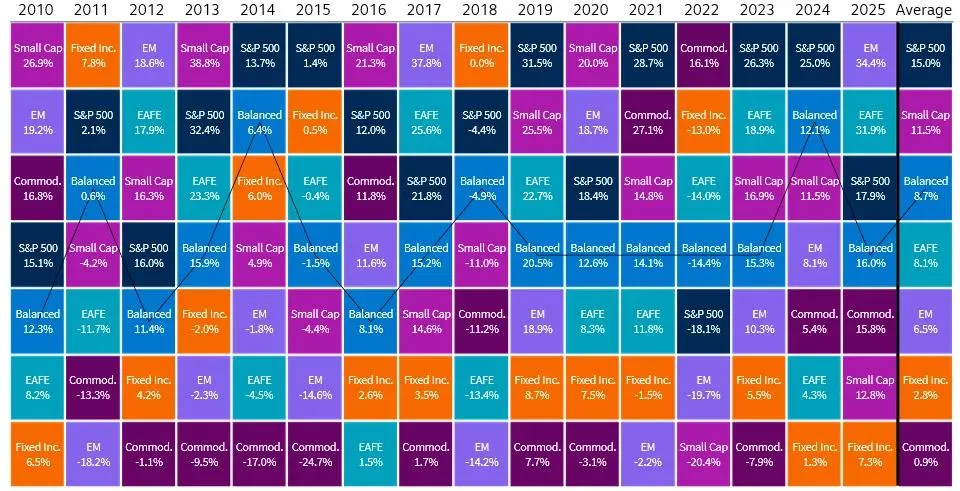
Source: Clearnomics, LSEG, Bloomberg. Asset classes are represented by the S&P 500, MSCI EM, MSCI EAFE, Russell 2000, iShares Core U.S. Bond Aggregate and Bloomberg Commodity Index. The Balanced Portfolio is a hypothetical 60/40 portfolio consisting of 40% U.S. Large Cap, 5% Small Cap, 10% International Developed Equities, 5% Emerging Market Equities, 35% U.S. Bonds, and 5% Commodities. Data as of December 31, 2025.
Principal Global Insights team
Chief Global Strategist
Director, Global Insights & Content Strategy
Market Strategist
Sr. Insights Strategist
Market Strategist
Insights Strategist
Learn more about the factors impacting markets and portfolios in the quarter ahead by downloading the full PDF.
Bloomberg U.S. High-Yield Corporate Bond Index is a rules-based, market-value-weighted index engineered to measure publicly issued non-investment grade USD fixed-rate, taxable and corporate bonds.
Bloomberg U.S. Corp High Yield 2% Issuer Capped Index is an unmanaged index comprised of fixed rate, non-investment grade debt securities that are dollar denominated. The index limits the maximum exposure to any one issuer to 2%.
Bloomberg U.S. Corporate Investment Grade Index includes publicly issued U.S. corporate and specified foreign debentures and secured notes that meet the specified maturity, liquidity and quality requirements. To qualify, bonds must be SEC-registered. The corporate sectors are industrial, utility and finance, which include both U.S. and non-U.S. corporations.
Bloomberg U.S. Treasury Index measures U.S. dollar-denominated, fixed-rate, nominal debt issued by the U.S. Treasury. Treasury bills are excluded by the maturity constraint. STRIPS are excluded from the index because their inclusion would result in double-counting.
MSCI ACWI Index includes large and mid cap stocks across developed and emerging market countries.
MSCI Brazil Index is designed to measure the performance of the large and mid cap segments of the Brazilian market.
MSCI China Index captures large and mid cap representation across China A shares, H shares, B shares, Red chips, P chips and foreign listings (e.g. ADRs).
MSCI EAFE Index is listed for foreign stock funds (EAFE refers to Europe, Australasia, and Far East). Widely accepted as a benchmark for international stock performance, the EAFE Index is an aggregate of 21 individual country indexes.
MSCI Emerging Markets Index consists of large and mid cap companies across 24 countries and represents 10% of the world market capitalization. The index covers approximately 85% of the free float-adjusted market capitalization in each country in each of the 24 countries.
MSCI Europe Index captures large and mid cap representation across 15 Developed Markets (DM) countries in Europe.
MSCI Europe Banks Index is composed of large and mid cap stocks across 15 Developed Markets countries in Europe. All securities in the index are classified in the Banks industry group (within the Financials sector) according to the Global Industry Classification Standard (GICS®).
MSCI Germany Index is designed to measure the performance of the large and mid cap segments of the German market.
MSCI India Index is designed to measure the performance of the large and mid cap segments of the Indian market.
MSCI Japan Index is designed to measure the performance of the large and mid cap segments of the Japanese market.
MSCI United Kingdom Index is designed to measure the performance of the large and mid cap segments of the UK market.
MSCI USA Growth Index captures large and mid cap securities exhibiting overall growth style characteristics in the U.S. The growth investment style characteristics for index construction are defined using five variables: long-term forward EPS growth rate, short-term forward EPS growth rate, current internal growth rate and long-term historical EPS growth trend and long-term historical sales per share growth trend.
MSCI USA Index is a market capitalization weighted index designed to measure the performance of equity securities in the top 85% by market capitalization of equity securities listed on stock exchanges in the United States.
MSCI USA Large Cap Index is designed to measure the performance of the large cap segments of the U.S. market. MSCI USA Mid Cap Index is designed to measure the performance of the mid cap segments of the U.S. market.
MSCI USA Mid Cap Index is designed to measure the performance of the mid cap segments of the U.S. market.
MSCI USA Quality Index aims to capture the performance of quality growth stocks by identifying stocks with high quality scores based on three main fundamental variables: high return on equity (ROE), stable year-over-year earnings growth and low financial leverage. The MSCI Quality Indexes complement existing MSCI Factor Indexes and can provide an effective diversification role in a portfolio of factor strategies.
MSCI USA Small Cap Index is designed to measure the performance of the small cap segment of the U.S. equity market.
MSCI USA Value Index captures large and mid cap U.S. securities exhibiting overall value style characteristics. The value investment style characteristics for index construction are defined using three variables: book value to price, 12-month forward earnings to price and dividend yield.
Standard & Poor’s 500 Index is a market capitalization-weighted index of 500 widely held stocks often used as a proxy for the stock market.
U.S. dollar index (USDX) is a measure of the value of the U.S. dollar relative to a basket of foreign currencies.
Market indices have been provided for comparison purposes only. They are unmanaged and do not reflect any fees or expenses. Individuals cannot invest directly in an index.
Risk considerations
Investing involves risk, including possible loss of principal. Past performance is no guarantee of future results. Equity investments involve greater risk, including higher volatility, than fixed-income investments. Fixed-income investments are subject to interest rate risk; as interest rates rise their value will decline. International and global investing involves greater risks such as currency fluctuations, political/social instability and differing accounting standards. Small- and mid-cap stocks may have additional risks including greater price volatility. Asset allocation and diversification do not ensure a profit or protect against a loss.
Important information
This material covers general information only and does not take account of any investor’s investment objectives or financial situation and should not be construed as specific investment advice, a recommendation, or be relied on in any way as a guarantee, promise, forecast or prediction of future events regarding an investment or the markets in general. The opinions and predictions expressed are subject to change without prior notice. The information presented has been derived from sources believed to be accurate; however, we do not independently verify or guarantee its accuracy or validity. Any reference to a specific investment or security does not constitute a recommendation to buy, sell, or hold such investment or security, nor an indication that the investment manager or its affiliates has recommended a specific security for any client account. Subject to any contrary provisions of applicable law, the investment manager and its affiliates, and their officers, directors, employees, agents, disclaim any express or implied warranty of reliability or accuracy and any responsibility arising in any way (including by reason of negligence) for errors or omissions in the information or data provided.
This material may contain ‘forward-looking’ information that is not purely historical in nature and may include, among other things, projections and forecasts. There is no guarantee that any forecasts made will come to pass. Reliance upon information in this material is at the sole discretion of the reader.
This material is not intended for distribution to or use by any person or entity in any jurisdiction or country where such distribution or use would be contrary to local law or regulation.
This document is intended for use in:
- The United States by Principal Global Investors, LLC, which is regulated by the U.S. Securities and Exchange Commission.
- Europe by Principal Global Investors (Ireland) Limited, 70 Sir John Rogerson’s Quay, Dublin 2, D02 R296, Ireland. Principal Global Investors (Ireland) Limited is regulated by the Central Bank of Ireland. Clients that do not directly contract with Principal Global Investors (Europe) Limited (“PGIE”) or Principal Global Investors (Ireland) Limited (“PGII”) will not benefit from the protections offered by the rules and regulations of the Financial Conduct Authority or the Central Bank of Ireland, including those enacted under MiFID II. Further, where clients do contract with PGIE or PGII, PGIE or PGII may delegate management authority to affiliates that are not authorised and regulated within Europe and in any such case, the client may not benefit from all protections offered by the rules and regulations of the Financial Conduct Authority, or the Central Bank of Ireland. In Europe, this document is directed exclusively at Professional Clients and Eligible Counterparties and should not be relied upon by Retail Clients (all as defined by the MiFID).
- United Kingdom by Principal Global Investors (Europe) Limited, Level 1, 1 Wood Street, London, EC2V 7 JB, registered in England, No. 03819986, which is authorized and regulated by the Financial Conduct Authority (“FCA”).
- United Arab Emirates by Principal Investor Management (DIFC) Limited, an entity registered in the Dubai International Financial Centre and authorized by the Dubai Financial Services Authority as an Authorised Firm, in its capacity as distributor / promoter of the products and services of Principal Asset Management. This document is delivered on an individual basis to the recipient and should not be passed on or otherwise distributed by the recipient to any other person or organisation.
- Singapore by Principal Global Investors (Singapore) Limited (ACRA Reg. No. 199603735H), which is regulated by the Monetary Authority of Singapore and is directed exclusively at institutional investors as defined by the Securities and Futures Act 2001. This advertisement or publication has not been reviewed by the Monetary Authority of Singapore.
- Australia by Principal Global Investors (Australia) Limited (ABN 45 102 488 068, AFS Licence No. 225385), which is regulated by the Australian Securities and Investments Commission and is only directed at wholesale clients as defined under Corporations Act 2001.
- This document is marketing material and is issued in Switzerland by Principal Global Investors (Switzerland) GmbH.
- Hong Kong SAR (China) by Principal Asset Management Company (Asia) Limited, which is regulated by the Securities and Futures Commission. This document has not been reviewed by the Securities and Futures Commission.
- Other APAC Countries/Jurisdictions, this material is issued for institutional investors only (or professional/sophisticated/qualified investors, as such term may apply in local jurisdictions) and is delivered on an individual basis to the recipient and should not be passed on, used by any person or entity in any jurisdiction or country where such distribution or use would be contrary to local law or regulation.
- Nothing in this document is, and shall not be considered as, an offer of financial products or services in Brazil. This presentation has been prepared for informational purposes only and is intended only for the designated recipients hereof. Principal Global Investors is not a Brazilian financial institution and is not licensed to and does not operate as a financial institution in Brazil. This document is intended for use in Brazil by Principal Asset Management Ltda., a Brazilian asset manager licensed and authorized to carry out its activities in Brazil according to Declaratory Act n. 9.408/07. This document is delivered on an individual basis to the recipient and should not be passed on or otherwise distributed by the recipient to any other person or organisation.
Insurance products and plan administrative services provided through Principal Life Insurance Co. Principal Funds, Inc. is distributed by Principal Funds Distributor, Inc. Securities are offered through Principal Securities, Inc., 800‐547‐7754, Member SIPC and/or independent broker/dealers. Principal Life, Principal Funds Distributor, Inc., and Principal Securities are members of the Principal Financial Group®, Des Moines, IA 50392.
© 2026, Principal Financial Services, Inc. Principal Asset Management℠ is a trade name of Principal Global Investors, LLC. Principal®, Principal Financial Group®, Principal Asset Management, and Principal and the logomark design are registered trademarks and service marks of Principal Financial Services, Inc., a Principal Financial Group company, in various countries around the world and may be used only with the permission of Principal Financial Services, Inc.
4994492