


At its December meeting, the Federal Open Market Committee (FOMC) decided to lower its benchmark policy rate by 25 basis points to 3.50%-3.75%. Three officials voted to dissent—two preferred to keep rates unchanged today, while one voted for a larger 50 basis point cut.
Today’s decision marks the third interest rate cut this year, bringing policy rates down by 175 basis points from the start of the easing cycle in September 2024. Chair Powell emphasized that policy is now “well-positioned” to await greater clarity in the data and to carefully assess labor market conditions and inflation trends. This signals that an extended pause is likely before the Federal Reserve resumes its easing cycle and delivers a few additional cuts.
Until just two weeks ago, the outcome of the December FOMC meeting remained a key source of market debate. In late September, consensus expectations indicated a likely December cut. However, a strong September employment report, combined with more hawkish commentary from several FOMC members, saw markets reduce the probability of a cut to just 20%. Ultimately, dovish communication ahead of the blackout period—without any pushback from Chair Powell—led markets to fully price in a cut, making today’s decision widely anticipated.
With limited economic data recently, due to the U.S. government shutdown, the Fed’s ability to gauge the state of the U.S. economy has been constrained. Nevertheless, Chair Powell offered several notable insights into the labor market, inflation, and the Fed’s broader policy stance, shedding light on today’s decision to cut rates and the inclination towards further easing.
- Labor market: Chair Powell noted that non-farm payrolls growth has averaged around 40,000 per month since April, but those numbers could be overstated by around 60,000 per month – in other words, job creation may, in fact, be sitting in negative territory. While he acknowledged that this may partially reflect a shrinking labor force, the labor market is clearly slowing.
- Inflation: Powell pointed out that core services price pressures have been waning, and while this has been offset by a pickup in core goods inflation, price pressures have been generally confined to sectors impacted by tariffs. While not signaling outright relief, these dynamics suggest that inflation concerns have moderated in recent months.
- Dual mandate: Powell also acknowledged the unusual tension between the Fed’s two mandates—elevated inflation alongside rising unemployment. He indicated, however, that the Fed now feels well-positioned to pause and assess how the economy responds to recent policy moves.
- Neutral rate: Estimates of the neutral rate vary widely within the FOMC. At 3.5%, the Fed funds rate now sits comfortably within the “plausible” range, though Powell suggested it is near the upper end. This leaves room for additional easing as the Fed seeks to normalize policy.
- AI productivity: As in most economic discussions today, AI played a prominent role in the press conference. Powell expressed optimism about potential productivity gains but cautioned that AI’s impact on the labor market remains limited for now—a dynamic that will require close monitoring. Looking ahead, the Fed’s challenge will be calibrating policy in an environment increasingly shaped by structural forces rather than cyclical trends.
- Balance sheet: The Fed announced plans to begin purchasing Treasury bills on December 12 to maintain ample reserves, underscoring its ability to leverage tools beyond rate policy to ensure market stability. This move should have no impact on its policy stance.
FOMC dot projections
December 2025
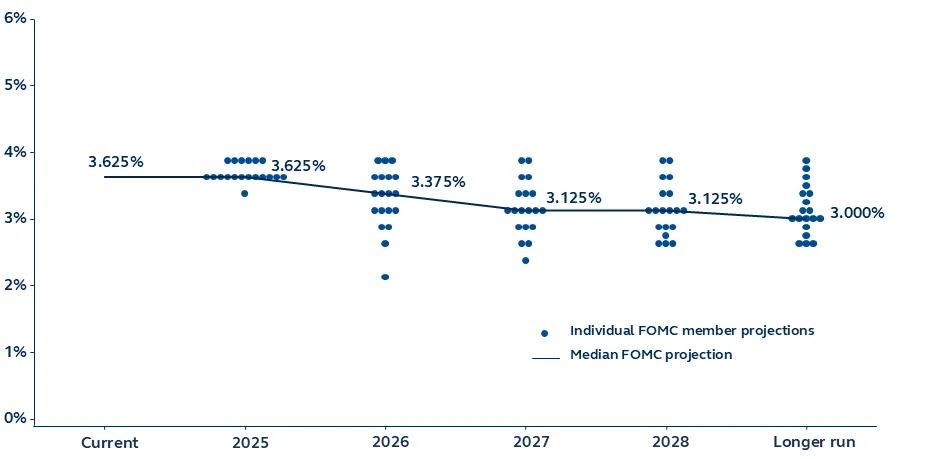
Source: Federal Reserve, Clearnomics, Principal Asset Management. Data as of December 10, 2025.
The new Summary of Economic Projections released today highlighted the Fed’s slightly more optimistic assessment of the economy and its expectation for a cautious easing cycle, with the median projection showing just one 25bp rate cut in 2026, and one in 2027.
- The GDP growth forecast edged up from 1.6% to 1.7% for 2025, from 1.8% to 2.3% for 2026, and from 1.9% to 2.0% for 2027.
- These upward revisions reflect the Fed’s view of solid economic conditions, supported by resilient consumer spending and AI-driven capital investment.
- Importantly, Chair Powell noted that the upgrade to the 2026 growth forecast was at least partially reflective of the government shutdown distortions - (roughly 0.2% shaved from 2025 and added back in 2026 – in other words, without the distortion, the 2025 forecast would have been 1.9% and 2026 would have been 2.1%).
- The unemployment rate forecast remained unchanged at 4.5% for 2025, declining slightly to 4.4% in 2026 and 4.2% in 2027.
- Powell acknowledged that unemployment is not projected to decline significantly despite strong growth forecasts, stating productivity as a likely cause.
- The headline PCE inflation forecast for 2025 was revised down from 3% to 2.9%, for 2026 from 2.6% to 2.4%, while the 2027 and 2028 forecasts remain unchanged at 2.1% and 2.0%, respectively.
- The Fed’s projections reflect the view that tariff-related price increases are expected to have a one-time effect. Once these pass through, inflation should continue easing toward the 2% target.
The Fed’s dot plot was largely unchanged from September, with median projections for the Fed funds rate at 3.4% in 2026, and 3.1% in 2027, implying just one 25bps cut in each year. For comparison, the market is currently pricing in two 25bps reductions next year.
The range of estimates has widened, reflecting a wide dispersion in views. Interestingly, several regional Fed presidents (some presumably non-voting members) would have preferred to keep rates unchanged today, suggesting a slightly more hawkish view. Indeed, the number of hawks for 2026 stands at 7 members, nearly 40% of the 19-member committee.
Policy outlook
The divisions within the Fed should not come as a surprise to markets. Given the recent scarcity of economic data, the wide dispersion in neutral rate estimates, and the ongoing tension between the Fed’s dual mandates, it is hard to imagine any scenario that would produce unanimous voting.
Chair Powell’s generally upbeat assessment of the U.S. economy and optimism around productivity gains suggest that only modest further easing is likely from here. The combined influence of AI-driven investment, fiscal stimulus, and labor supply dynamics makes it increasingly difficult for the Fed to justify significant additional cuts—particularly with inflation still above target and expected to remain elevated over the next two years.
We expect the Fed to take a prolonged pause now. Some additional easing is likely to occur in 2026, but it will likely be limited and the timing will be contingent upon stronger evidence and greater confidence in the health of the U.S. economy.
Investing involves risk, including possible loss of principal. Past performance is no guarantee of future results.
Views and opinions expressed are accurate as of the date of this communication and are subject to change without notice. This material may contain ‘forward-looking’ information that is not purely historical in nature and may include, among other things, projections and forecasts. There is no guarantee that any forecasts made will come to pass. Reliance upon information in this material is at the sole discretion of the reader.
The information in the article should not be construed as investment advice or a recommendation for the purchase or sale of any security. The general information it contains does not take account of any investor’s investment objectives, particular needs, or financial situation.
Insurance products and plan administrative services provided through Principal Life Insurance Co. Principal Funds, Inc. is distributed by Principal Funds Distributor, Inc. Securities are offered through Principal Securities, Inc., 800‐547‐7754, Member SIPC and/or independent broker/dealers. Principal Life, Principal Funds Distributor, Inc., and Principal Securities are members of the Principal Financial Group®, Des Moines, IA 50392.
5056535

No information