

At the start of the year, the macro environment was defined by resilient growth and moderating inflation—supporting expectations for gradual Fed rate cuts. Combined with attractive starting yields, this created a constructive backdrop for fixed income. That outlook has shifted with the escalation of conflict in the Middle East. With inflation still running above the Fed’s target, higher energy prices risk limiting the Fed’s ability to respond if growth slows or labor market conditions weaken. For now, economic growth and credit fundamentals remain intact, but the path forward is less certain. Despite heightened volatility, investor demand for income and portfolio ballast has not abated. While the conflict has pushed rates higher and modestly widened credit spreads, elevated yields provide improved compensation and support continued allocations to bonds.
Policy volatility: Navigating geopolitical and economic challenges
The current environment is marked by geopolitical volatility, as markets grapple with the war in Iran, surging oil and gasoline prices amid already sticky inflationary pressures, and a complicated U.S. labor market. The Fed’s easing cycle, occurring amid sustained inflation exacerbated by geopolitical tensions (with Iran now top of the list), creates a backdrop of uncertainty. This scenario complicates investor sentiment and contributes to a steepening yield curve. While this creates opportunities for agile investors, it also calls for close risk monitoring.
Credit fundamentals: Resilience amidst market dynamics
From a credit perspective, resilience is key. Investors should maintain a focus on robust technicals and credit fundamentals while remaining attentive to the overall economic conditions. Companies still have healthy balance sheets, and earnings are running above expectations. Nevertheless, geopolitical headline risks, primarily the war in the Middle East, and lingering trade sensitivities can lead to significant sector dispersion, underscoring the importance of active issuer selection and credit discipline.
Valuations: Spreads widen in response to the Iran war and supply
Valuations present a complex picture as spreads widened in the first months of the year, driven by a surge in new issuance and uncertainty surrounding the war in Iran. While further spread widening is possible as the war continues, opportunities persist, especially within municipal bonds, investment-grade credit, and high yield. As geopolitical and Fed policy uncertainty continue, careful security selection is critical. In this environment, disciplined active management will be essential to identify durable income, manage downside risks, and capture pockets of value amid ongoing volatility.
Market environment
Year-to-date performance, spread, and yield for various fixed income indices
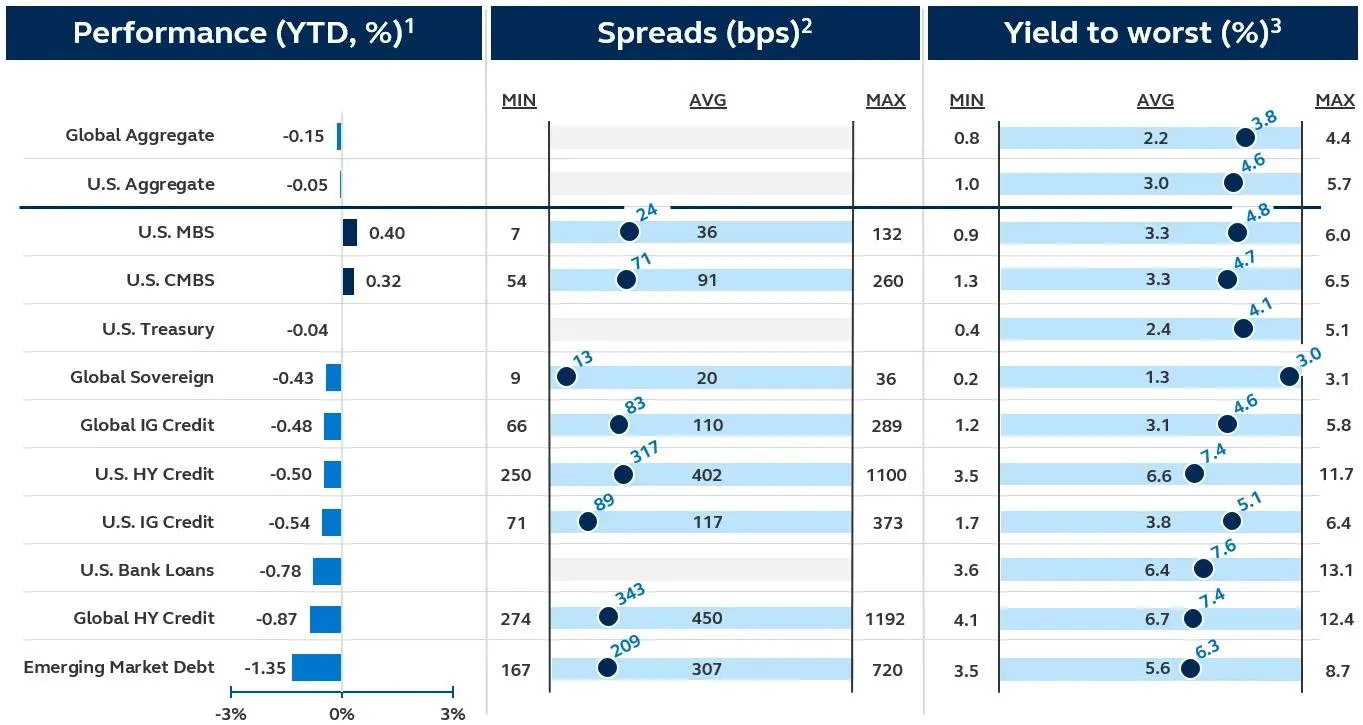
Source: Bloomberg, Principal Asset Management. Data are as of March 31, 2026. 1 Total returns for representative indices. 2 Spread to Treasury. Min, max, and average based on last 10 years. 3 Index yield to worst. Min, max, and average based on last 10 years. Weighted average yield-to-maturity reflected for U.S. Bank Loans. Indices are unmanaged and do not take into account fees, expenses, and transaction costs, and it is not possible to invest in an index.
U.S. outlook
The U.S. economy entered 2026 with solid momentum, supported by resilient consumption, strong corporate balance sheets, and expectations for Fed easing. However, geopolitical developments— particularly the Iran conflict—have introduced a new layer of uncertainty, influencing energy markets, inflation expectations, and broader risk sentiment.
Despite this shift, the fixed income backdrop remains constructive. Corporate fundamentals are stable, and default risk expectations remain contained. Technicals are balanced, with strong demand continuing to absorb elevated issuance in an orderly market. Meanwhile, valuations have improved as earlier expectations for aggressive rate cuts have been repriced, leading to more attractive all-in and real yields relative to recent history.
While geopolitical risks may drive near-term volatility, the alignment of fundamentals, technicals, and valuations supports a favorable outlook for fixed income investors.
Global outlook
The escalation in the Middle East has introduced a new layer of uncertainty into the global macro backdrop, creating competing forces for markets and policymakers. Higher energy prices are inflationary in the near term, but also risk weighing on growth—particularly in energy-importing regions such as Europe and Asia.
At the same time, governments are likely to increase fiscal spending to support energy markets and domestic economies, adding pressure to already stretched public finances. For central banks, this creates a difficult balancing act: inflation argues for patience, while slowing growth supports eventual easing.
The result is likely a period of policy inertia and heightened dispersion across regions and asset classes. In this environment, maintaining flexibility, emphasizing income, and managing downside risks remain key as geopolitical developments continue to unfold.
Investment implications
While economic challenges remain, we see opportunities in fixed income.
Investment grade credit remains well positioned despite a surge in issuance. While supply has been elevated, demand has kept pace, supported by attractive all-in yields and a broad investor base. Strong order books and continued access to global funding markets have helped the market absorb large deals efficiently.
Treasury yields remain a key anchor, particularly at the intermediate and long end of the curve. Even if policy rates decline, yields in the five- to ten-year segment should remain supported, offering compelling carry and income opportunities.
Fundamentals also remain solid, with corporate earnings holding up and balance sheets generally healthy. Against this backdrop, opportunities are concentrated in high-quality issuers and sectors with durable fundamentals, while more cyclical areas warrant greater selectivity.
High yield is entering a cautiously constructive but uncertain environment. Elevated starting yields in the mid-to-high single digits provide a strong income cushion and remain a key driver of return potential, even if spreads remain rangebound.
At the same time, spreads are increasingly sensitive to macro and geopolitical developments. Ongoing tensions in the Middle East and evolving rate expectations could lead to periods of volatility, with risk assets vulnerable to further repricing if uncertainty persists.
Selectivity is becoming more important across sectors. Consumer-facing industries face pressure from higher energy costs and persistent inflation, while more defensive areas and certain infrastructure-linked sectors offer relative stability. Primary market opportunities may also provide attractive entry points.
Overall, a disciplined, selective approach remains critical in the current environment.
Securitized debt enters the quarter on a balanced footing, supported by steady demand and generally solid fundamentals, even as rate volatility and geopolitical risks persist.
Mortgage-backed securities remain a key focus. Agency MBS performance has been sensitive to rate moves, with prepayment risk a central consideration, particularly if rates decline meaningfully. In non- agency markets, improving affordability and selective refinancing activity are supporting credit performance, with opportunities in higher-quality and structurally protected segments.
Across consumer credit, performance is diverging by income cohort. Higher-income borrowers remain resilient, while lower-income segments face pressure, contributing to elevated delinquencies in areas such as subprime auto.
Elsewhere, CMBS fundamentals are stabilizing, while CLOs face mixed conditions. In this environment, careful security selection and disciplined underwriting remain essential.
Municipals enter the coming quarters with a strong income profile and defensive characteristics, supported by robust demand and solid credit fundamentals. Tax-exempt yields remain compelling on an after-tax basis, continuing to attract both retail and institutional investors even as issuance stays elevated.
Supply has been concentrated in longer maturities, contributing to a steeper curve and enhancing income opportunities for investors willing to extend duration. The intermediate-to-long end of the curve offers particularly attractive compensation relative to other fixed income sectors.
Credit quality across the market remains generally stable, with many issuers benefiting from diverse revenue streams tied to essential services. While certain credits face localized fiscal pressures, municipals overall continue to offer resilience.
In this environment, municipals stand out as a reliable source of tax-efficient income with defensive portfolio benefits.
Emerging market debt faces a more uncertain backdrop as geopolitical tensions and higher energy prices reshape inflation, policy, and investor behavior. A higher structural oil price is likely to persist, creating inflationary pressure and limiting central bank flexibility across many emerging economies.
The impact is increasingly uneven across regions. Commodity exporters, particularly in Latin America and parts of Africa, may benefit from improved fiscal and external balances, while energy importers face rising costs, weaker growth, and currency pressure. Fiscal dynamics are also becoming more challenging as governments respond to higher energy prices with subsidies and support measures.
Despite these headwinds, investor demand for yield remains supportive in the near term. However, flows are likely to concentrate in higher-quality issuers, leading to greater dispersion and a more differentiated opportunity set across markets.
Private credit is approaching an inflection point, with strong demand and attractive deal flow set against rising scrutiny and emerging structural risks. The asset class continues to benefit from durable borrower fundamentals and steady capital inflows, particularly in middle-market lending.
However, dispersion across managers is becoming more pronounced. In some areas, looser underwriting, higher leverage, and strategy drift have introduced vulnerabilities, particularly among larger platforms and vehicles facing liquidity and valuation pressures. Recent dislocations have highlighted the importance of structure and alignment.
At the same time, market conditions are shifting in favor of lenders. Terms and pricing have become more attractive, and core middle-market direct lending continues to offer a consistent pipeline of opportunities.
The long-term case for private credit remains intact, but outcomes will increasingly depend on manager discipline and underwriting quality.
For Public Distribution in the U.S. For Institutional, Professional, Qualified and/or Wholesale Investor Use Only in other Permitted Jurisdictions as defined by local laws and regulations.
Risk considerations
Investing involves risk, including possible loss of principal. Past Performance does not guarantee future return. All financial investments involve an element of risk. Therefore, the value of the investment and the income from it will vary and the initial investment amount cannot be guaranteed. Fixed‐‐income investment options are subject to interest rate risk, and their value will decline as interest rates rise. Potential investors should be aware that Investment grade corporate bonds carry credit risks, default risk, liquidity risks, currency risks, operational risks, legal risks, counterparty risk and valuation risks. Lower‐rated securities are subject to additional credit and default risks. Asset backed securities are affected by the quality of the credit extended in the underlying loans. As a result, their quality is dependent upon the selection of the commercial mortgage portfolio and the cash flow generated by the commercial real estate assets. Commercial Mortgage‐Backed Securities carry greater risk compared to other securities in times of market stress. There may be less information on the financial condition of municipal issuers than for public corporations. The market for municipal bonds may be less liquid than for other bonds. Emerging market debt may be subject to heightened default and liquidity risk. Private credit involves an investment in non‐publicly traded securities which are subject to illiquidity risk. Portfolios that invest in private credit may be leveraged and may engage in speculative investment practices that increase the risk of investment loss. Asset allocation and diversification do not ensure a profit or protect against a loss. International and global investing involves greater risks such as currency fluctuations, political/ social instability and differing accounting standards.
Important information
This material covers general information only and does not take account of any investor’s investment objectives or financial situation and should not be construed as specific investment advice, a recommendation, or be relied on in any way as a guarantee, promise, forecast or prediction of future events regarding an investment or the markets in general. Information presented has been derived from sources believed to be accurate; however, we do not independently verify or guarantee its accuracy or validity. Any reference to a specific investment or security does not constitute a recommendation to buy, sell, or hold such investment or security, nor an indication that the investment manager or its affiliates has recommended a specific security for any client account. Subject to any contrary provisions of applicable law, the investment manager and its affiliates, and their officers, directors, employees, agents, disclaim any express or implied warranty of reliability or accuracy and any responsibility arising in any way (including by reason of negligence) for errors or omissions in the information or data provided.
This material may contain ‘forward‐looking’ information that is not purely historical in nature and may include, among other things, projections, and forecasts. There is no guarantee that any forecasts made will come to pass. Reliance upon information in this material is at the sole discretion of the reader.
All figures shown in this document are in U.S. dollars unless otherwise noted. All assets under management figures shown in this document are gross figures, before fees, transaction costs and other expenses and may include leverage, unless otherwise noted. Assets under management may include model‐only assets managed by the firm, where the firm has no control as to whether investment recommendations are accepted, or the firm does not have trading authority over the assets.
Index performance information reflects no deduction for fees, expenses, or taxes. Indices are unmanaged and individuals cannot invest directly in an index.
This document is intent for use in:
- The United States by Principal Global Investors, LLC, which is regulated by the U.S. Securities and Exchange Commission.
- Europe by Principal Global Investors (Ireland) Limited, 70 Sir John Rogerson’s Quay, Dublin 2, D02 R296, Ireland. Principal Global Investors (Ireland) Limited is regulated by the Central Bank of Ireland. Clients that do not directly contract with Principal Global Investors (Europe) Limited (“PGIE”) or Principal Global Investors (Ireland) Limited (“PGII”) will not benefit from the protections offered by the rules and regulations of the Financial Conduct Authority or the Central Bank of Ireland, including those enacted under MiFID II. Further, where clients do contract with PGIE or PGII, PGIE or PGII may delegate management authority to affiliates that are not authorized and regulated within Europe and in any such case, the client may not benefit from all protections offered by the rules and regulations of the Financial Conduct Authority, or the Central Bank of Ireland. In Europe, this document is directed exclusively at Professional Clients and Eligible Counterparties and should not be relied upon by Retail Clients (all as defined by the MiFID).
- United Kingdom by Principal Global Investors (Europe) Limited, Level 1, 1 Wood Street, London, EC2V 7 JB, registered in England, No. 03819986, which is authorized and regulated by the Financial Conduct Authority (“FCA”).
- This document is marketing material and is issued in Switzerland by Principal Global Investors (Switzerland) GmbH.
- United Arab Emirates by Principal Investor Management (DIFC) Limited, an entity registered in the Dubai International Financial Centre and authorized by the Dubai Financial Services Authority as an Authorised Firm, in its capacity as distributor / promoter of the products and services of Principal Asset Management. This document is delivered on an individual basis to the recipient and should not be passed on or otherwise distributed by the recipient to any other person or organisation.
- Singapore by Principal Global Investors (Singapore) Limited (ACRA Reg. No.199603735H), which is regulated by the Monetary Authority of Singapore and is directed exclusively at institutional investors as defined by the Securities and Futures Act 2001. This advertisement or publication has not been reviewed by the Monetary Authority of Singapore.
- Australia by Principal Global Investors (Australia) Limited (ABN 45 102 488 068, AFS Licence No. 225385), which is regulated by the Australian Securities and Investments Commission and is only directed at wholesale clients as defined under Corporations Act 2001.
- Hong Kong SAR by Principal Asset Management Company (Asia) Limited, which is regulated by the Securities and Futures Commission. This document has not been reviewed by the Securities and Futures Commission. This document may only be distributed, circulated or issued to persons who are Professional Investors under the Securities and Futures Ordinance and any rules made under that Ordinance or as otherwise permitted by that Ordinance.
- Other APAC Countries/Jurisdictions. This material is issued for Institutional Investors only (or professional/sophisticated/qualified investors, as such term may apply in local jurisdictions) and is delivered on an individual basis to the recipient and should not be passed on, used by any person or entity in any jurisdiction or country where such distribution or use would be contrary to local law or regulation.
Principal Global Investors, LLC (PGI) is registered with the U.S. Commodity Futures Trading Commission (CFTC) as a commodity trading advisor (CTA), a commodity pool operator (CPO) and is a member of the National Futures Association (NFA). PGI advises qualified eligible persons (QEPs) under CFTC Regulation 4.7.
Principal Asset Management℠ is a trade name of Principal Global Investors, LLC.
Insurance products and plan administrative services provided through Principal Life Insurance Co. Principal Funds, Inc. is distributed by Principal Funds Distributor, Inc. Securities are offered through Principal Securities, Inc., 800‐547‐7754, Member SIPC and/or independent broker/dealers. Principal Life, Principal Funds Distributor, Inc., and Principal Securities are members of the Principal Financial Group®, Des Moines, IA 50392.
Principal Fixed Income is an investment team within Principal Global Investors.
© 2026 Principal Financial Services, Inc. Principal®, Principal Financial Group®, Principal Asset Management, and Principal and the logomark design are registered trademarks and service marks of Principal Financial Services, Inc., a Principal Financial Group company, in various countries around the world and may be used only with the permission of Principal Financial Services, Inc.
5371412