


A new wave of enthusiasm for private alternative assets is transforming the defined contribution (DC) marketplace. For years, institutional investors, particularly defined benefit (DB) plans, have steadily expanded their exposure to private real estate, private equity, private credit, and infrastructure. Wealth management platforms have followed, supported by a maturing set of interval funds, evergreen structures, and semi-liquid vehicles.
Recent signals reinforce the strength of that demand. A July 2025 survey of plan advisors conducted by Cogent/Escalant found that approximately 40% would consider recommending private equity, private credit, and direct real estate for DC clients. Policy developments, particularly discussions around “democratizing access” to alternative investments, have only intensified the conversation. In a world where over 50% of retail financial advisors allocate over 10% to illiquid alternative assets, it is no wonder that many think that the current 0.5% allocation to illiquid alternatives across the D.C. industry leaves significant room for expansion.
DC plans have lagged in implementing alternatives because they operate under different constraints than DB portfolios or wealth accounts: daily liquidity, individualized withdrawal and loan activity, and fiduciary oversight focused on protecting millions of retail investors, many of whom are in default investments. For the last 20 years, alternative assets in D.C. have been implemented primarily by large and mega-market companies that hold direct real estate in their target date strategies. The question for the Defined Contribution industry is whether and how to extend the use of alternatives with new asset classes such as private equity, private credit, and infrastructure; new vehicles such as managed accounts; and new segments with smaller plans.
Recent policy developments have also helped clarify the regulatory backdrop for alternatives in defined contribution plans. In March 2026, the U.S. Department of Labor issued proposed guidance reaffirming that defined contribution fiduciaries may consider alternative investments, provided that decisions are grounded in a prudent, well-documented process aligned with participant outcomes. While the guidance does not endorse any specific asset class, it reinforces that alternatives can be evaluated on the same fiduciary basis as traditional investments, placing emphasis on purpose, structure, fees, liquidity, and operational readiness.
At Principal Financial Group, we see significant opportunities for alternative investments. Through our general account, we hold nearly $6.0 billion in alternative strategies.
To address these and other risks, advisors and plan sponsors should adopt six best practices that we see in successful alternative asset implementations.
- Individually evaluate each alternative asset class, realizing that these asset classes differ in their objectives, benchmarks, and product structures.
- Set a liquidity strategy for implementing private assets that ensures participants have access to liquidity, even in tail risk scenarios.
- Construct a portfolio putting purpose before product, identifying the specific objectives for each private asset under consideration that enhances public asset options. Assess the benefits of adding the asset class against the fees associated with that addition.
- Carefully consider the appropriate benchmark for each private asset, realizing that you might need to make assumptions to accommodate incomplete data.
- Bring rigor to manager due diligence, recognizing that the dispersion of returns among private asset managers often exceeds that of public equity managers.
- Build an operational implementation strategy working with your record-keeper.
In the pages that follow, we outline considerations for plan sponsors and advisors as they approach each step in implementing illiquid investments.
“Alternatives” is often used as a catch-all. Here, we focus on the private markets most relevant to DC design: direct real estate, private credit, private equity, and infrastructure. These are the areas where the defining characteristics of private markets, including the potential for enhanced long-term risk-adjusted returns, limited liquidity, long investment horizons, and valuation lags, are most visible and most impactful within a multi-asset DC framework.
Even within this more focused definition, private alternatives are far from uniform. Direct real estate behaves very differently from REITs; private credit follows its own cash flow patterns and credit cycle sensitivities; infrastructure brings a distinct set of inflation-linked and regulatory features. In some cases, differences can even emerge within an asset class. (Consider the differences between a buyout strategy and a private equity secondaries fund, or between core real estate and opportunistic real estate.) Treating private alternatives as a single, interchangeable “alts bucket” obscures the decisions fiduciaries actually face: purpose, structure, vehicle terms, liquidity, valuation, and manager selection for each distinct allocation.
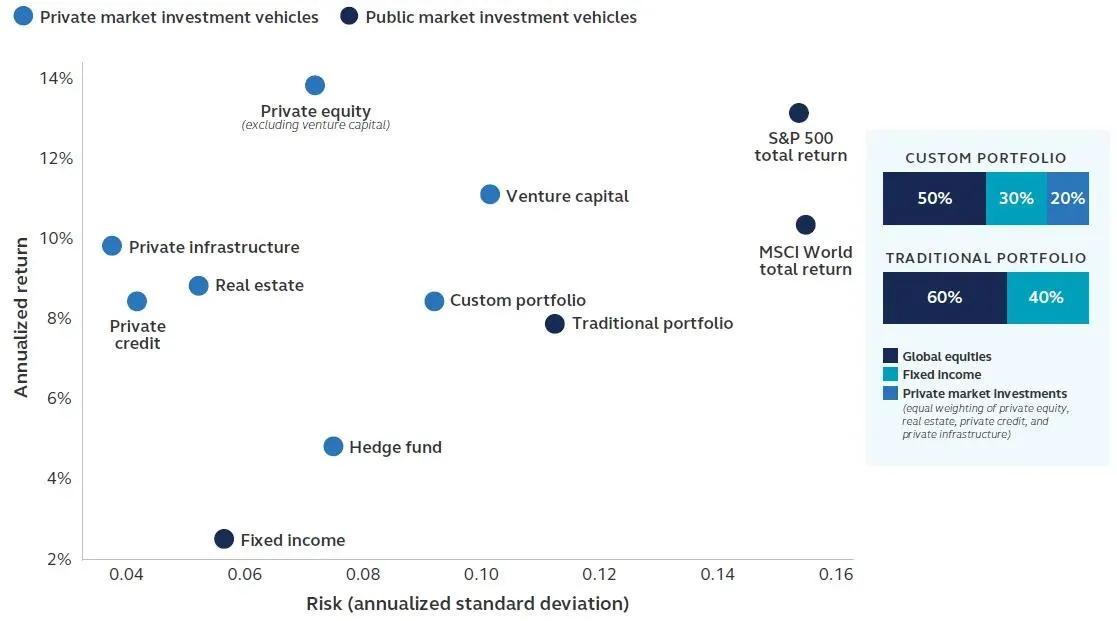
Source: Preqin, Bloomberg, Principal Asset Management. Data as of September 30, 2024. Hedge funds: Bloomberg All Hedge Fund Index; Fixed income: Bloomberg US Agg Index; Private Equity excl. VC: Preqin Private Equity excl. VC Index; Venture capital: Preqin Venture Capital Index; Private Debt: Preqin Private Debt Index; Real Estate: Preqin Real Estate Index; Infrastructure: Preqin Infrastructure Index; U.S. equities: S&P 500 Total Return Index; Global equities: MSCI World Total Return Index. Indices are unmanaged and do not take into account fees, expenses, and transaction costs and it is not possible to invest in an index.
| Private Equity | Real Estate | Infrastructure | Private Debt | |
|---|---|---|---|---|
| Endowments | 16.9% | 2.9% | 0.1% | 0.6% |
| Family Offices | 20% | 7.4% | 1.4% | 1.3% |
| Private Pensions | 7.2% | 2.8% | 1.0% | 0.2% |
| Public Pensions | 11.3% | 9.3% | 4.1% | 4.0% |
| Wealth Managers | 11% | 8% | 5% | 7% |
Source: Brookfield, Preqin, Principal Asset Management. Data as of December 31, 2024.
Daily liquidity is foundational to the DC ecosystem. Private assets, by contrast, are designed to operate on multi-year horizons with limited redemption windows. Managing that mismatch is the single most important design challenge to including alternatives in DC plan lineups.
The principle is simple: participant actions should not force sales of illiquid holdings. In practice, that means sourcing liquidity from the public sleeves of the portfolio (equities, bonds, dedicated liquidity sleeves) rather than from illiquid assets. Although there are some cases where participants can elect to invest in options with liquidity gates, most participants need daily liquidity.
Within a defined contribution plan, private assets are generally placed in professionally managed solutions. Historically, target date strategies have been the preferred vehicles. Because they are pooled vehicles, target date strategies can meet cash flow needs across all their participants and generate some predictability in cash flows based on the target date strategy held. Many target date managers use public asset sleeves within their portfolio to generate liquidity in lieu of tapping private asset allocations. Others use alternative strategies that have liquidity buffers built into their allocation.
Many leading target date strategies have launched or announced series that incorporate private assets. Approaches vary considerably across managers, asset classes, vehicle types, valuation cadences, and liquidity terms.
| Firm | Target Date Fund Market Share4 | TDF w/Private Markets Series Name | Series Assets5 | Inception Year |
|---|---|---|---|---|
| Vanguard | 36.3% | Not yet announced | None | No launch planned yet |
| Fidelity | 14.1% | Fidelity Freedom Series | $8 Billion | 2021 - the year private markets were incorporated into the series |
| T. Rowe Price | 11.6% | Announced a launch in late 2025, but name is not yet available | None | Planned mid 2026 launch |
| Blackrock | 10.0% | Great Gray Panorix CIT Series | None | Yet to be launched |
| Capital Group | 8.7% | Announced a launch in mid 2025, but name is not yet available | None | Yet to be launched |
| State Street | 5.4% | State Street Target Retirement IndexPlus | None | Still to be launched |
| JP Morgan | 2.6% | JPMCB SmartRetirement DRE CIT Series | $7.6 Billion | 2007 |
| Nuveen | 2.6% | Nuveen Lifecycle Series | $400 Million | 2024 |
Source: Principal Asset Management analysis. Data as of April 30, 2026.
Regulatory context: Clarified fiduciary standards for alternatives in DC plans
Recent guidance from the U.S. Department of Labor has helped clarify the regulatory backdrop for alternative investments in defined contribution plans. In March 2026, the Department proposed a safe-harbor that reinforces ERISA’s emphasis on fiduciary process rather than asset class distinctions. The guidance does not promote or discourage alternatives, nor does it alter fiduciary obligations. Instead, it affirms that any investment, whether public or private, may be considered when evaluated through a prudent, well-documented process focused on participant outcomes.
While the rule has not yet been finalized, it provides clear directional guidance for investors. Fiduciaries are expected to define the role an investment is intended to play, assess trade-offs among liquidity, fees, and operational complexity, and ensure the structure aligns with the realities of participant behavior and plan administration. In this context, alternatives may be appropriate in defined contribution plans when implemented thoughtfully, with disciplined governance, intentional portfolio design, and operational readiness consistent with DC standards.
Every private asset included in a defined contribution portfolio should serve a clearly defined purpose. The objective is not simply to “add alternatives,” but to thoughtfully incorporate assets that can improve long-term outcomes in specific, defensible ways. That clarity around what role an asset is meant to play ultimately guides allocation size, implementation, and expectations.
Within that framework, different alternative assets can address different portfolio needs. Direct real estate may provide income resilience and diversification benefits for portfolios composed primarily of stocks and bonds. Private credit can provide spread-driven income with underwriting dispersion that doesn’t always mirror public credit. Private equity is a long-horizon growth engine, but one that introduces vintage risk and wide dispersion across managers and strategies. Infrastructure brings yet another profile, combining regulated or contracted cash flows with potential inflation sensitivity.
Once the role of each asset is established, investors can turn to sizing and pacing decisions. Many define their alternative allocation sleeve by balancing an illiquidity budget, a risk budget, and a fee budget. Others rely on scenario analysis to establish allocation ranges rather than fixed targets. Commitments can then be paced within those ranges, allowing investors to observe real-world cash flow behavior through different market environments before scaling further.
Against this backdrop, direct real estate often resonates with defined contribution plan sponsors because of its potential to smooth return paths during periods of market stress. In our experience working with large DC investors, interest in the asset class extends beyond diversification to its historical ability to retain value during equity market drawdowns. Empirically, during calendar quarters in which public equities declined by 10% or more over the past two decades, direct real estate generally experienced either modest declines or outright appreciation, while REITs tended to track broader equity weakness more closely. For plans where participant withdrawals can occur at any time, that return stability can be particularly meaningful.
Importantly, investors should maintain realistic expectations. During periods of severe market stress, correlations can rise as valuations adjust, and alternative vehicles may impose liquidity constraints. The benefits of private assets, including direct real estate, are best assessed over full market cycles rather than individual quarters.
Finally, fees must be evaluated in the context of the value an alternative investment is expected to deliver. Transparency is essential, and performance fees, where applicable, warrant scrutiny. For example, in the case of private equity, are performance fees paid on unrealized gains? Regardless of whether performance fees are included, one should also assess how the alternative allocation affects total portfolio fees. While fees should never be the sole decision driver, higher-cost strategies require proportionately higher conviction in the role they play and the outcomes they are designed to achieve.
Defined contribution is fundamentally a daily NAV system, whereas many private assets are appraised quarterly or modeled. The result can be an appearance of calm that reflects reporting methods more than economic risk. To maintain both fiduciary discipline and participant fairness, portfolio designs should begin by understanding how marks are set, how quickly they incorporate new information, and how fair value adjustments are handled during volatile periods.
Sometimes returns of alternative assets must be adjusted by making unsmoothed assumptions. In other cases, carefully chosen public proxies for risk budgeting and stress testing can be used. Benchmarks deserve the same scrutiny. A daily valued evergreen private credit vehicle should not be measured against a vintage year private debt index that presumes capital calls and multi-year lockups. Where perfect benchmarks do not exist, document a composite approach—peer groups, adjusted indices, or proxies—and acknowledge its limitations.
Keep in mind that different alternative asset classes have varying levels of maturity in developing daily valued, illiquid products. In the direct real estate space, 14 strategies are included in the NCREIF NFI-DP Index (daily priced funds), with inception dates ranging from January 1982 to January 2022.
Private markets are not homogeneous, and manager skills vary far more widely than in public markets. Dispersion between top- and bottom-quartile private equity managers is 7.5 times greater than in large-cap equities; private credit dispersion is 2.8 times greater; and direct real estate dispersion is equal to that of large-cap equities. This dispersion can directly affect participant outcomes.
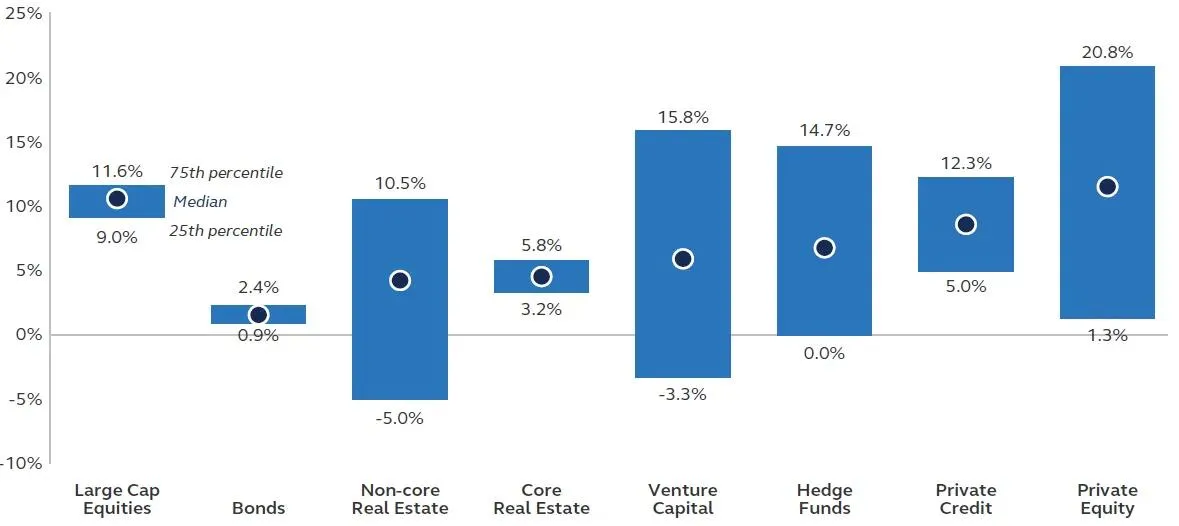
Source: J.P. Morgan Asset Management Guide to Alternatives. Data are based on availability as of January 31, 2026.
All categories are global. Large Cap Equities and Bonds are based on the Morningstar Global Large Stock Blend and Global Bond (not hedged) categories, respectively. Core Real Estate is based on the MSCI Global Property Fund Index. Private Credit, Non-core Real Estate, Private Equity and Venture Capital are based on indices from the MSCI Private Capital Universe. Hedge Funds are based on the PivotalPath index. Manager dispersion is based on annual returns over the 10-year period indicated for: Large Cap Equities, Bonds and Hedge Funds. *Manager dispersion is based on annual returns over the 10-year period ending 3Q25 for Core Real Estate. Manager dispersion is based on the 10-year internal rate of return (IRR) ending 3Q25 for: Private Credit, Non-core Real Estate, Private Equity and Venture Capital.
After examining the structural, investment, and operational considerations involved in bringing private alternatives into DC plans, it becomes clear that the ultimate test of any design is not theoretical: it is how the alternative allocation works for participants and how reliably the plan can support it over time.
Implementing alternatives with safeguards. The retirement industry is coming together to provide the right safeguards around implementing alternatives. Specifically, the use of alternatives in Defined Contribution is almost entirely driven by placement in managed vehicles, such as managed accounts or target-date strategies.
These vehicles allow professionals to oversee manager selection and asset allocation while also smoothing out potential issues related to participant communication. Stand-alone private options can present communications challenges, with net asset value numbers that don’t move in sync with public market movements and redemption rules that may differ from those of publicly traded mutual funds. However, packaged solutions can mitigate these issues because performance reporting and redemptions typically occur at the package level.
Operational readiness. When packaged solutions are used, the main source of implementation complexity for alternatives lies in operational readiness. Daily NAV processing, fractional-share handling, liquidity windows, valuation timing, and error-correction policies all matter more in private markets than in traditional DC allocations. These are not details around the edges; they are the foundation to incorporating alternatives that ensure fairness and orderly operation.
A plan that incorporates private assets successfully is one where:
- the recordkeeper, trustee, and manager operate from the same liquidity assumptions,
- governance documents reflect reality rather than aspiration,
- monitoring frameworks evaluate both investment performance and operational health, and
- stress-tested playbooks are in place before they are needed.
If any of these elements are not aligned, private allocations can create more noise than value for the plan and its participants.
Private alternatives can play a constructive role in defined contribution plans. They work best when liquidity is engineered intentionally, valuation and benchmarking are realistic, manager selection is disciplined, and the operational framework is as strong as the investment rationale.
For most sponsors, the right question is not,“How do we add alternatives?” It is, “Are our participants, our plan, and our operating partners truly prepared for them?”
If the answer is yes, private assets can become a durable component of a long-term retirement strategy. If not, the most fiduciary sound decision is to wait until readiness is in place. Either path can be prudent. The value lies in making the alternatives decision deliberately.
Footnotes
Mercer and CAIS, The State of Alternative Investments in Wealth Management: 2026 Survey Report, survey conducted September–October 2025.
Principal Financial Group. Data as of March 31, 2026.
Principal Real Estate. Data as of March 31, 2026.
Sway Research, Data as of June 30, 2025.
Morningstar, FundFire, Data as of September 30, 2025.
Investments such as stable value, guaranteed insurance contracts, and direct real estate have requirements that plan sponsors give notice for redemptions. However, the Defined Contribution industry has not restricted participant withdrawals.
Morningstar. Private Assets Meet Retirement Managed Accounts. Morningstar Research, 2024.
For Public Distribution in the U.S. For Institutional, Professional, Qualified and/or Wholesale Investor Use Only in other Permitted Jurisdictions as defined by local laws and regulations.
Risk Considerations
Past performance is no guarantee of future results. Investing involves risk, including possible loss of principal invested. Equity markets are subject to many factors, including economic conditions, government regulations, market sentiment, local and international political events, and environmental and technological issues that may impact return and volatility. International investing involves greater risks such as currency fluctuations, political/social instability, and differing accounting standards. Asset allocation and diversification do not ensure a profit or protect against a loss. Investment risk may be magnified with alternative investment strategies due to their use of arbitrage, leverage, and derivatives. Fixed-income investments are subject to interest rate risk; as interest rates rise their value will decline.
Important information
This material covers general information only and does not take account of any investor’s investment objectives or financial situation and should not be construed as specific investment advice, a recommendation, or be relied on in any way as a guarantee, promise, forecast or prediction of future events regarding an investment or the markets in general. Information presented has been derived from sources believed to be accurate; however, we do not independently verify or guarantee its accuracy or validity. Any reference to a specific investment or security does not constitute a recommendation to buy, sell, or hold such investment or security, nor an indication that the investment manager or its affiliates has recommended a specific security for any client account. Subject to any contrary provisions of applicable law, the investment manager and its affiliates, and their officers, directors, employees, agents, disclaim any express or implied warranty of reliability or accuracy and any responsibility arising in any way (including by reason of negligence) for errors or omissions in the information or data provided.
This material may contain ‘forward‐looking’ information that is not purely historical in nature and may include, among other things, projections, and forecasts. There is no guarantee that any forecasts made will come to pass. Reliance upon information in this material is at the sole discretion of the reader.
This material is not intended for distribution to or use by any person or entity in any jurisdiction or country where such distribution or use would be contrary to local law or regulation.
This document is intended for use in:
- The United States by Principal Global Investors, LLC, which is regulated by the U.S. Securities and Exchange Commission.
- Europe by Principal Global Investors (Ireland) Limited, 70 Sir John Rogerson’s Quay, Dublin 2, D02 R296, Ireland. Principal Global Investors (Ireland) Limited is regulated by the Central Bank of Ireland. Clients that do not directly contract with Principal Global Investors (Europe) Limited (“PGIE”) or Principal Global Investors (Ireland) Limited (“PGII”) will not benefit from the protections offered by the rules and regulations of the Financial Conduct Authority or the Central Bank of Ireland, including those enacted under MiFID II. Further, where clients do contract with PGIE or PGII, PGIE or PGII may delegate management authority to affiliates that are not authorized and regulated within Europe and in any such case, the client may not benefit from all protections offered by the rules and regulations of the Financial Conduct Authority, or the Central Bank of Ireland. In Europe, this document is directed exclusively at Professional Clients and Eligible Counterparties and should not be relied upon by Retail Clients (all as defined by the MiFID).
- United Kingdom by Principal Global Investors (Europe) Limited, Level 1, 1 Wood Street, London, EC2V 7 JB, registered in England, No. 03819986, which is authorized and regulated by the Financial Conduct Authority (“FCA”).
- This document is marketing material and is issued in Switzerland by Principal Global Investors (Switzerland) GmbH.
- United Arab Emirates by Principal Investor Management (DIFC) Limited, an entity registered in the Dubai International Financial Centre and authorized by the Dubai Financial Services Authority as an Authorised Firm, in its capacity as distributor / promoter of the products and services of Principal Asset Management. This document is delivered on an individual basis to the recipient and should not be passed on or otherwise distributed by the recipient to any other person or organisation.
- Singapore by Principal Global Investors (Singapore) Limited (ACRA Reg. No.199603735H), which is regulated by the Monetary Authority of Singapore and is directed exclusively at institutional investors as defined by the Securities and Futures Act 2001. This advertisement or publication has not been reviewed by the Monetary Authority of Singapore.
- Australia by Principal Global Investors (Australia) Limited (ABN 45 102 488 068, AFS Licence No. 225385), which is regulated by the Australian Securities and Investments Commission and is only directed at wholesale clients as defined under Corporations Act 2001.
- Hong Kong SAR by Principal Asset Management Company (Asia) Limited, which is regulated by the Securities and Futures Commission. This document has not been reviewed by the Securities and Futures Commission. This document may only be distributed, circulated or issued to persons who are Professional Investors under the Securities and Futures Ordinance and any rules made under that Ordinance or as otherwise permitted by that Ordinance.
- Other APAC Countries/Jurisdictions. This material is issued for Institutional Investors only (or professional/sophisticated/qualified investors, as such term may apply in local jurisdictions) and is delivered on an individual basis to the recipient and should not be passed on, used by any person or entity in any jurisdiction or country where such distribution or use would be contrary to local law or regulation.
- Nothing in this document is, and shall not be considered as, an offer of financial products or services in Brazil. This presentation has been prepared for informational purposes only and is intended only for the designated recipients hereof. Principal Global Investors is not a Brazilian financial institution and is not licensed to and does not operate as a financial institution in Brazil. This document is intended for use in Brazil by Principal Asset Management Ltda., a Brazilian asset manager licensed and authorized to carry out its activities in Brazil according to Declaratory Act n. 9.408/07. This document is delivered on an individual basis to the recipient and should not be passed on or otherwise distributed by the recipient to any other person or organisation.
- Principal Global Investors is not acting as agent for, or in conjunction with any Principal Financial Group affiliate domiciled in Mexico. By accepting this Presentation, the recipient confirms that is an Institutional and/or Accredited Investors pursuant to Articles 2 Sections XVI, XVII and 8 of the Mexican Securities Market Law (“LMV”). In case of not complying with the requirements established in the LMV, the recipient must notify it immediately, since the recipient has not the right to receive the information in order to comply with the LMV.
- The exhibition of this material in Chile does not constitute an offer for the purchase or sale of any local or foreign security, nor does it pretend to promote or advertise determinate securities or its issuers or facilitate the purchase or sale of determinate securities. This material has been prepared exclusively to be used in one on one presentation with institutional or qualified investors, capable of properly evaluating the limitations and risks involved in investment decisions. This presentation should not be provided to anyone else.
Principal Global Investors, LLC (PGI) is registered with the U.S. Commodity Futures Trading Commission (CFTC) as a commodity trading advisor (CTA), a commodity pool operator (CPO) and is a member of the National Futures Association (NFA). PGI advises qualified eligible persons (QEPs) under CFTC Regulation 4.7.
Principal Asset Management℠ is a trade name of Principal Global Investors, LLC.
© 2026 Principal Financial Services, Inc. Principal®, Principal Financial Group®, Principal Asset Management, and Principal and the logomark design are registered trademarks and service marks of Principal Financial Services, Inc., a Principal Financial Group company, in various countries around the world and may be used only with the permission of Principal Financial Services, Inc.
5455515