

As the fourth quarter begins, the macro backdrop is defined by resilient growth, stubborn inflation, and a sharp repricing of the policy outlook. Strong consumer spending, robust earnings, and AI-related capital investment continue to support the economy, but higher energy prices and limited progress toward the Fed’s inflation target are keeping rates elevated. Fixed income markets have absorbed these pressures with notable resilience. More importantly, higher rates have restored bonds to their traditional role as a meaningful source of portfolio income. Credit fundamentals remain sound, yet tighter spreads, heavy issuance, and greater rate volatility leave less room for error, reinforcing the need to balance liquidity, quality, and selective credit risk.
Policy volatility: Higher for longer, with less guidance
Resilient growth, sticky inflation, and renewed energy pressures prompted a September Fed rate hike, and with less forward guidance, rate volatility is likely to persist. Elevated yields offer attractive carry and a return cushion, but abrupt moves can pressure valuations.
Credit fundamentals: Resilient, with greater dispersion
Healthy balance sheets, solid earnings, stable leverage, and continued market access broadly support credit. High yield also benefits from improved index quality, while municipal, securitized, emerging market, and private credit offer distinct sources of resilience. Still, higher rates and energy costs affect borrowers differently. Active selection should favor durable cash flows, pricing power, seniority, structural protection, and adequate compensation for issuer-specific risks.
Valuations: Income is attractive, but selectivity matters
Attractive all-in yields stand in contrast to tight credit spreads. Strong demand, reinvestment flows, and manageable net new supply remain supportive, although heavy technology and municipal issuance may create pockets of pressure. With limited room for broad spread compression, returns should depend more on carry, security selection, and relative value across sectors and maturities. Liquidity also provides flexibility to add risk when volatility creates more compelling entry points.
Market environment
Year-to-date performance, spread, and yield for various fixed income indices
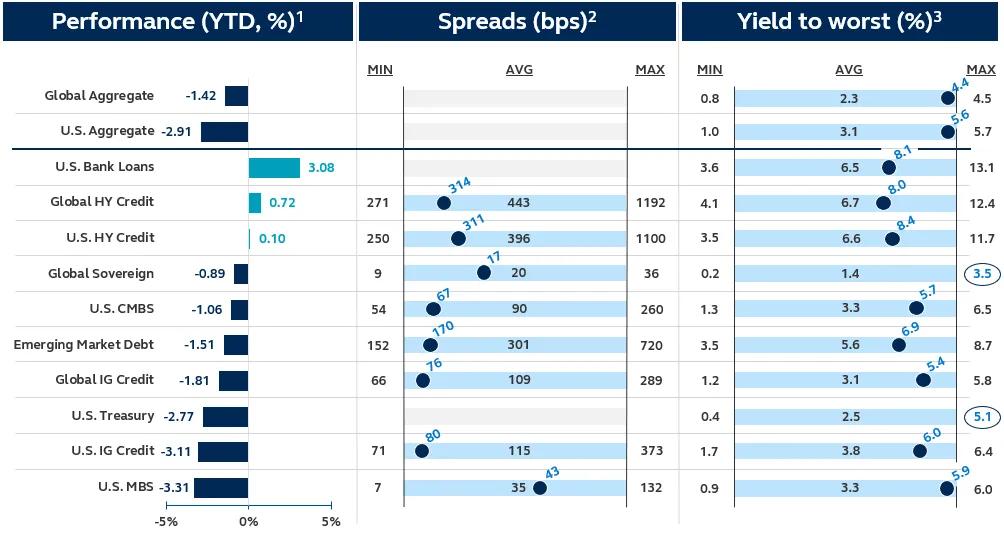
Source: Bloomberg, Principal Asset Management. Data as of September 30, 2026. 1Total returns for representative indices. 2 Spread to Treasury. Min, max, and average based on last 10 years. 3Index yield to worst. Min, max, and average based on last 10 years. Weighted average yield-to-maturity reflected for U.S. Bank Loans. Indices are unmanaged and do not take into account fees, expenses, and transaction costs, and it is not possible to invest in an index.
U.S. outlook
The U.S. economy remains resilient, supported by steady consumer spending, robust corporate earnings, healthy balance sheets, and continued investment in AI infrastructure. However, the sharp rise in interest rates and limited near-term progress on inflation have complicated the outlook, while geopolitical tensions, energy volatility, and elevated corporate issuance could contribute to further market turbulence.
These crosscurrents support a constructive but disciplined view of risk assets. Strong fundamentals continue to favor credit over the medium term, but historically tight spreads and policy uncertainty argue for modest restraint and sufficient liquidity. Periods of market volatility may ultimately create more attractive opportunities to deploy capital and increase risk exposure.
Global outlook
The global economy enters the fourth quarter with resilient growth, but renewed energy pressures are complicating the outlook for inflation and monetary policy. Higher oil prices and persistent geopolitical risk are limiting central banks’ flexibility, making rate cuts unlikely across major developed economies through year-end and reinforcing a higher-for-longer rate environment.
Technology investment remains an important source of support, with AI-related demand benefiting semiconductor, server, component, and manufacturing activity across Europe and Asia. However, regional conditions are becoming more differentiated. Europe faces greater pressure from higher borrowing costs, elevated energy prices, and weather-related disruptions, while technology-oriented economies in Asia continue to benefit from strong external demand.
Investment implications
While economic challenges remain, we see opportunities in fixed income.
Investment grade credit enters the fourth quarter with a supportive backdrop characterized by attractive yields, healthy corporate fundamentals, and persistent demand. Despite a record pace of gross issuance and continued funding needs tied to AI investment, the market has absorbed supply well, aided by strong reinvestment flows and steady investor demand for income.
Corporate balance sheets remain healthy, consumer spending has held up, and earnings growth continues to support credit quality. At the same time, inflation, energy prices, and Federal Reserve policy remain important areas to monitor. With spreads near historically tight levels, the investment grade story is increasingly driven by income, fundamentals, and market technicals rather than broad spread tightening. For investors seeking quality income and diversification, the asset class remains on solid footing heading into year-end.
High yield enters the fourth quarter with a supportive fundamental backdrop, though rising Treasury yields, higher energy prices, and episodic equity market weakness have introduced greater uncertainty. Corporate earnings remain healthy, credit quality across the market continues to improve, and companies generally maintain access to capital despite a higher-rate environment.
The asset class has also benefited from a shorter duration profile, helping reduce sensitivity to rate volatility relative to many other fixed income sectors. At the same time, yields have risen to more attractive levels, reinforcing the role of income in overall return expectations.
Looking ahead, the key question is whether higher energy costs persist long enough to pressure margins and consumer demand. While fundamentals remain supportive, a selective approach remains important as spreads stay below long-term averages and risks become more differentiated across issuers and sectors.
Securitized debt enters the fourth quarter with one of its strongest advantages in years: attractive all-in yields. Higher rates have increased income potential across the asset class, while generally sound underwriting and stable credit fundamentals continue to provide support in many sectors.
At the same time, the backdrop remains uneven. Elevated rates are weighing on housing affordability, slowing origination activity, and creating distinct winners and losers across securitized markets. Higher-quality mortgage, commercial real estate, and select asset-backed securities have generally held up better, while lower-rated and consumer-sensitive areas have faced greater pressure.
As policy uncertainty, Treasury supply, and geopolitical risks continue to influence markets, structural protections, collateral quality, and careful security selection remain increasingly important differentiators.
Municipals bonds enter the fourth quarter with improved valuations after rising rates and record issuance pressured performance during the third quarter. While macro forces overwhelmed otherwise supportive technicals, the adjustment has created a more compelling income backdrop and improved taxable-equivalent yields for many investors.
Supply is expected to remain elevated through year-end, while uncertainty around interest rates, elections, inflation, and geopolitical developments may continue to drive volatility. At the same time, municipal credit fundamentals remain generally healthy, and higher coupons are increasing the contribution of income to total return potential.
As the market navigates a higher-rate environment, investors are focusing more closely on maturity, coupon structure, and credit quality as key drivers of outcomes.
Emerging market debt continues to benefit from attractive carry and resilient investor demand, with a softer U.S. dollar helping offset some of the pressure from higher global yields. While the asset class remains supported by income generation, valuations have become more mixed as markets have absorbed much of the uncertainty surrounding geopolitics, energy prices, and monetary policy.
Country and regional dynamics are becoming increasingly important. Elevated oil prices are supporting commodity exporters while creating more difficult inflation and policy challenges for importers. At the same time, differences in central bank credibility, fiscal conditions, and political developments are driving wider performance dispersion across markets.
As a result, the outlook remains constructive, but increasingly selective, with country-specific factors playing a larger role in outcomes than broad market trends.
Private credit enters the fourth quarter with a constructive backdrop supported by resilient economic growth and continued activity across the lower and core middle market. While transaction volumes in some areas remain uneven, healthy sponsored and non-sponsored deal flow continues to support a robust opportunity set.
The asset class's floating-rate structure remains a key differentiator in a higher-rate environment, helping income adjust as rates change while limiting duration sensitivity. At the same time, leverage levels have declined, credit structures have improved, and spreads remain attractive relative to many public credit markets.
As economic conditions evolve, the focus remains on businesses with resilient cash flows, recurring demand, and durable competitive positions. These characteristics continue to support private credit's role as a source of income and diversification within a broader fixed income allocation.
For Public Distribution in the U.S. For Institutional, Professional, Qualified and/or Wholesale Investor Use Only in other Permitted Jurisdictions as defined by local laws and regulations.
Risk considerations
Investing involves risk, including possible loss of principal. Past Performance does not guarantee future return. All financial investments involve an element of risk. Therefore, the value of the investment and the income from it will vary and the initial investment amount cannot be guaranteed. Fixed‐‐income investment options are subject to interest rate risk, and their value will decline as interest rates rise. Potential investors should be aware that Investment grade corporate bonds carry credit risks, default risk, liquidity risks, currency risks, operational risks, legal risks, counterparty risk and valuation risks. Lower‐rated securities are subject to additional credit and default risks. Asset backed securities are affected by the quality of the credit extended in the underlying loans. As a result, their quality is dependent upon the selection of the commercial mortgage portfolio and the cash flow generated by the commercial real estate assets. Commercial Mortgage‐Backed Securities carry greater risk compared to other securities in times of market stress. There may be less information on the financial condition of municipal issuers than for public corporations. The market for municipal bonds may be less liquid than for other bonds. Emerging market debt may be subject to heightened default and liquidity risk. Private credit involves an investment in non‐publicly traded securities which are subject to illiquidity risk. Portfolios that invest in private credit may be leveraged and may engage in speculative investment practices that increase the risk of investment loss. Asset allocation and diversification do not ensure a profit or protect against a loss. International and global investing involves greater risks such as currency fluctuations, political/ social instability and differing accounting standards.
This document is intended for use in:
- The United States by Principal Global Investors, LLC, which is regulated by the U.S. Securities and Exchange Commission.
- Europe by Principal Global Investors (Ireland) Limited, 70 Sir John Rogerson’s Quay, Dublin 2, D02 R296, Ireland. Principal Global Investors (Ireland) Limited is regulated by the Central Bank of Ireland. Clients that do not directly contract with Principal Global Investors (Europe) Limited (“PGIE”) or Principal Global Investors (Ireland) Limited (“PGII”) will not benefit from the protections offered by the rules and regulations of the Financial Conduct Authority or the Central Bank of Ireland, including those enacted under MiFID II. Further, where clients do contract with PGIE or PGII, PGIE or PGII may delegate management authority to affiliates that are not authorized and regulated within Europe and in any such case, the client may not benefit from all protections offered by the rules and regulations of the Financial Conduct Authority, or the Central Bank of Ireland. In Europe, this document is directed exclusively at Professional Clients and Eligible Counterparties and should not be relied upon by Retail Clients (all as defined by the MiFID).
- United Kingdom by Principal Global Investors (Europe) Limited, Level 1, 1 Wood Street, London, EC2V 7 JB, registered in England, No. 03819986, which is authorized and regulated by the Financial Conduct Authority (“FCA”).
- This document is marketing material and is issued in Switzerland by Principal Global Investors (Switzerland) GmbH.
- United Arab Emirates by Principal Investor Management (DIFC) Limited, an entity registered in the Dubai International Financial Centre and authorized by the Dubai Financial Services Authority as an Authorised Firm, in its capacity as distributor / promoter of the products and services of Principal Asset Management. This document is delivered on an individual basis to the recipient and should not be passed on or otherwise distributed by the recipient to any other person or organisation.
- Singapore by Principal Global Investors (Singapore) Limited (ACRA Reg. No.199603735H), which is regulated by the Monetary Authority of Singapore and is directed exclusively at institutional investors as defined by the Securities and Futures Act 2001. This advertisement or publication has not been reviewed by the Monetary Authority of Singapore.
- Australia by Principal Global Investors (Australia) Limited (ABN 45 102 488 068, AFS Licence No. 225385), which is regulated by the Australian Securities and Investments Commission and is only directed at wholesale clients as defined under Corporations Act 2001.
- Hong Kong SAR by Principal Asset Management Company (Asia) Limited, which is regulated by the Securities and Futures Commission. This document has not been reviewed by the Securities and Futures Commission. This document may only be distributed, circulated or issued to persons who are Professional Investors under the Securities and Futures Ordinance and any rules made under that Ordinance or as otherwise permitted by that Ordinance.
- Other APAC Countries/Jurisdictions. This material is issued for Institutional Investors only (or professional/sophisticated/qualified investors, as such term may apply in local jurisdictions) and is delivered on an individual basis to the recipient and should not be passed on, used by any person or entity in any jurisdiction or country where such distribution or use would be contrary to local law or regulation.
- Nothing in this document is, and shall not be considered as, an offer of financial products or services in Brazil. This presentation has been prepared for informational purposes only and is intended only for the designated recipients hereof. Principal Global Investors is not a Brazilian financial institution and is not licensed to and does not operate as a financial institution in Brazil. This document is intended for use in Brazil by Principal Asset Management Ltda., a Brazilian asset manager licensed and authorized to carry out its activities in Brazil according to Declaratory Act n. 9.408/07. This document is delivered on an individual basis to the recipient and should not be passed on or otherwise distributed by the recipient to any other person or organisation.
- Principal Global Investors is not acting as agent for, or in conjunction with any Principal Financial Group affiliate domiciled in Mexico. By accepting this Presentation, the recipient confirms that is an Institutional and/or Accredited Investors pursuant to Articles 2 Sections XVI, XVII and 8 of the Mexican Securities Market Law (“LMV”). In case of not complying with the requirements established in the LMV, the recipient must notify it immediately, since the recipient has not the right to receive the information in order to comply with the LMV.
- The exhibition of this material in Chile does not constitute an offer for the purchase or sale of any local or foreign security, nor does it pretend to promote or advertise determinate securities or its issuers or facilitate the purchase or sale of determinate securities. This material has been prepared exclusively to be used in one on one presentation with institutional or qualified investors, capable of properly evaluating the limitations and risks involved in investment decisions. This presentation should not be provided to anyone else.
Principal Global Investors, LLC (PGI) is registered with the U.S. Commodity Futures Trading Commission (CFTC) as a commodity trading advisor (CTA), a commodity pool operator (CPO) and is a member of the National Futures Association (NFA). PGI advises qualified eligible persons (QEPs) under CFTC Regulation 4.7.
Principal Asset Management℠ is a trade name of Principal Global Investors, LLC.
Principal Fixed Income is an investment team within Principal Global Investors.
© 2026 Principal Financial Services, Inc. Principal®, Principal Financial Group®, Principal Asset Management, and Principal and the logomark design are registered trademarks and service marks of Principal Financial Services, Inc., a Principal Financial Group company, in various countries around the world and may be used only with the permission of Principal Financial Services, Inc.
5993610