


As multi-asset portfolios have become more equity-risk driven, allocators increasingly view liquid alternatives as a structural portfolio component rather than a tactical overlay. Inflation uncertainty, policy shifts, market concentration, and episodic liquidity stress have made traditional stock-and-bond diversification less reliable. For institutional investors, the key question is how to incorporate liquid alternatives in a disciplined way that improves resilience without compromising governance, transparency, or flexibility.
Traditional portfolios can appear diversified while still deriving most of their risk from equity and bond market exposure. Public equities, investment-grade credit, high yield, and some private assets may all be tied to similar growth, liquidity, and risk-premia cycles. During periods of market stress, correlations often rise, weakening diversification precisely when investors need it most.
Diversified multi-strategy liquid alternatives can help address that vulnerability by enhancing resilience, reducing drawdowns, and may help improve return consistency without materially sacrificing long-term return objectives. They occupy a distinct role between traditional fixed income and private alternatives:
- More flexible than private markets, with liquidity that allows exposures to be added, reduced, or rebalanced without waiting for capital calls or redemption queues.
- More differentiated than many core bond exposures, with access to multiple sources of alpha and risk premia.
- More adaptable than single-strategy mandates, with the ability to tilt toward richer opportunity sets as conditions change.
When implemented deliberately, multi-strategy liquid alternatives can improve the quality of portfolio risk, not simply reduce the amount of risk.
Multi-strategy approaches combine diversifying, return-enhancing, and risk-mitigating strategies within one framework. Their objective is to improve total-portfolio efficiency by broadening return drivers, reducing reliance on directional beta, and preserving the ability to rebalance as conditions evolve. Daily liquidity and transparent pricing also make these strategies easier to size, monitor, and integrate within governance frameworks than many private or limited-liquidity alternatives.
Liquid alternatives as a core allocation
For investors with an existing alternatives allocation, diversified multi-strategy liquid alternatives are often best positioned as a core holding rather than a collection of satellites. Many portfolios may benefit from a stable, diversified sleeve with multiple sources of return than from narrowly targeted strategies whose effectiveness may depend on a single regime or dislocation. A core allocation can provide ballast while leaving room for more opportunistic views.
Liquid alternatives generally encompass three broad strategy types:
- Diversifying strategies (e.g., relative value/arbitrage, global macro, event-driven merger arbitrage, trend-following)
- Return-enhancing strategies (e.g., directional equity hedge, tactical trading, event-driven special situations, directional credit long/short)
- Risk-reducing strategies (e.g., some relative value sub-strategies, defensive overlays, volatility management)
When combined in one actively managed portfolio, these components can support dynamic allocation across market environments, reduce reliance on any single return source, and simplify governance. Rather than underwriting multiple separate strategy bets, an investment committee can use one risk-budgeted structure that combines relative value, macro, opportunistic, and defensive exposures.
In practice, many institutional allocators and large RIAs assign about half of their liquid alternatives exposure to a diversified core strategy, using single-strategy allocations selectively. The core allocation is intended to seek portfolio benefits, while satellites can be added or trimmed as opportunity sets change.
Liquid alternatives complement private markets
For portfolios with meaningful private markets exposure, liquid alternatives can play a valuable supporting role. Private markets may offer attractive long-term return potential, but they also introduce pacing risk, denominator effects, vintage-year concentration, delayed price discovery, and limited rebalancing flexibility. Liquid alternatives can help offset those challenges through daily liquidity, transparent pricing, and differentiated return streams.
They can also serve as an interim allocation while investors await deployment into private markets, keeping assets productively invested while preserving flexibility to meet capital calls, rebalance policy exposures, or respond to liquidity needs.
Liquid alternatives can complement private market investments in several practical ways:
| Private markets | Liquid alternatives |
|---|---|
| Illiquid or semi-liquid / long lockups | Daily liquidity / tactical flexibility to invest more, resize, or redeem |
| Directional exposure | Hedged, diversified exposures |
| Smoothed valuation | Transparent daily pricing |
For investors without an existing alternatives allocation, the central implementation decision is where to source capital. Three approaches are common, each reflecting the economic role a liquid alternatives allocation is intended to play.
Volatility-based funding (fixed income replacement)
This approach has become more relevant as fixed income’s traditional diversification role has become less dependable. Replacing a portion of fixed income with a diversified liquid alternatives strategy may improve the balance between resilience, flexibility, and expected return potential.
This approach is particularly relevant when:
- Fixed income offers limited real return potential
- Diversification from bonds is less reliable
Empirical outcomes show that replacing fixed income with liquid alternatives tends to deliver:
- Higher Sharpe ratios
- Improved drawdown profiles
- Historically greater return consistency
For institutions facing low expected real returns from core bonds, the trade-off can be compelling. Traditional fixed income still matters for liability hedging, liquidity management, and capital preservation, but liquid alternatives may be a more effective use of capital when the goal is to strengthen the return-seeking diversifier sleeve. This approach may offer return potential relative to a traditional portfolio, though it typically provides the least volatility reduction of the three funding methods.
Equity beta-adjusted funding
This framework recognizes that a dollar allocated to liquid alternatives does not carry the same economic exposure as a dollar allocated to public equity, and therefore should not necessarily be funded dollar-for-dollar from equities.
Under this framework:
- ~25% of the allocation is funded from equities
- The remaining ~75% is funded from fixed income
This approach better aligns capital allocation with underlying risk exposure and can be useful for institutions that want to preserve strategic growth exposure while moderating drawdown risk. It balances return improvement and volatility reduction, though the return benefit is lower than volatility-based funding, and the volatility reduction is less significant than pro-rata funding.
Pro-rata funding from traditional assets
A straightforward method is to fund liquid alternatives proportionally from equities and fixed income. For example, a 60/40 portfolio allocating 10% to liquid alternatives would fund:
- 6% from equities
- 4% from fixed income
While simple, this approach preserves a relatively high concentration of equity-driven risk and therefore fails to realize the full benefit of diversification. It primarily lowers volatility, with only a modest impact on return. For first-time allocations, however, pro-rata funding can be practical because it minimizes governance friction and is easy to implement within an existing policy portfolio.
Insights from portfolio optimization
Many mean-variance optimization frameworks have consistently favored liquid alternatives over traditional fixed income across broad segments of the efficient frontier. A strategy with moderate return expectations, lower directional beta, and relatively low correlation to stocks and bonds can improve portfolio efficiency even if it is not the highest-returning component on a standalone basis.
This reflects:
- Low correlation to both equities and bonds
- Competitive risk-adjusted returns
Institutions rarely rely on unconstrained optimization outputs. Real-world allocations are shaped by governance preferences, liquidity budgets, benchmark structure, manager availability, operational due diligence, and tolerance for complexity. Even so, optimization results suggest liquid alternatives may merit consideration as a strategic allocation rather than a marginal accessory.
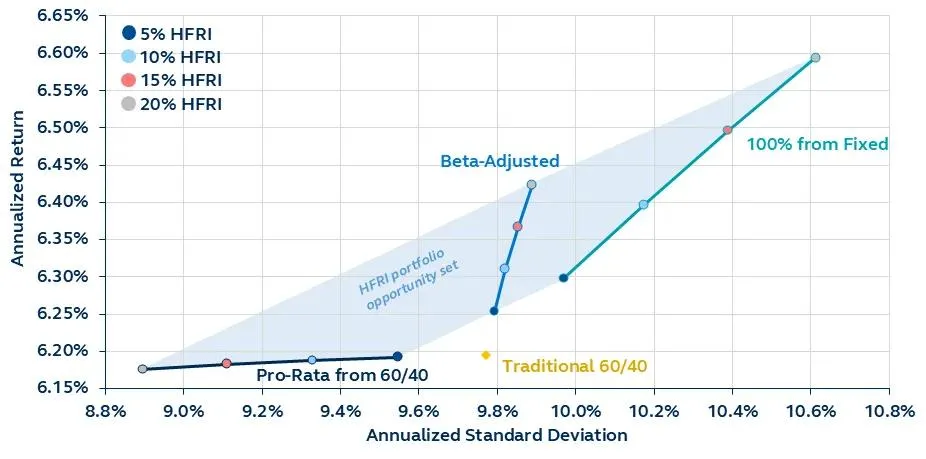
Source: Morningstar, Principal Asset Management. Period: January 1, 2001–July 31, 2026. Data as of July 31, 2026.
Institutional benchmarks
Institutional allocations provide helpful context. Alternatives account for roughly one-fifth of institutional portfolios on average, while endowments and foundations maintain meaningfully higher allocations. Within those portfolios, hedge fund and hedge fund-like exposures remain established tools for investors seeking diversification, smoother return paths, and opportunities beyond long-only public markets.
- Average institutional alternatives allocation: approximately 20%
- Endowments and foundations: more than 35% in alternatives
- Hedge fund allocation within endowment and foundation portfolios: roughly 13%
Liquid alternatives are most comparable to hedge funds in their intended portfolio role, but they offer greater liquidity, transparency, and accessibility. That distinction matters for institutions seeking alternative exposure while maintaining tighter governance controls, more frequent valuation, and simpler rebalancing.
Practical implementation
The appropriate allocation depends on the role liquid alternatives are expected to play, the size of the existing private markets book, the institution’s liquidity profile, and governance capacity. A modest initial position can be justified on portfolio-efficiency grounds, while larger allocations may make sense for investors seeking to reduce dependence on traditional stock-and-bond beta.
- Typical alternatives allocations range from 0–20%
- Within that range, increasing allocations typically leads to:
- Lower volatility
- Reduced drawdowns
- Improved return consistency
In an environment of elevated macro uncertainty, equity-dominated portfolios, and constrained fixed income returns, liquid alternatives can serve as a durable and flexible component of modern portfolio construction. For institutional investors, the key point is that liquid alternatives need not be treated as a peripheral allocation or a tactical expression of short-term market views. Used thoughtfully, they can function as structural portfolio capital—broadening return drivers, improving diversification quality, and supporting a more resilient total-portfolio outcome across changing market regimes.
For Public Distribution in the U.S. For Institutional, Professional, Qualified and/or Wholesale Investor Use Only in other Permitted Jurisdictions as defined by local laws and regulations.
Risk Considerations
Investing involves risk, including the possible loss of principal. Past performance does not guarantee future results. Asset allocation, diversification, and risk management techniques do not ensure a profit, protect against loss, or guarantee investment outcomes. Alternative investments are not appropriate for all investors and should not constitute an entire investment program. Liquid alternative strategies are subject to market risk and may experience periods of volatility and loss. These strategies may use derivatives, leverage, short positions, and other investment techniques that increase volatility, liquidity risk, counterparty risk, and the potential for capital loss. Alternative investment strategies may not provide the anticipated diversification or other portfolio benefits and may underperform traditional equity and fixed income investments in certain market environments. There can be no assurance that any investment strategy will achieve its objectives or deliver expected benefits, including diversification, reduced volatility, improved risk-adjusted returns, or enhanced portfolio resilience.
Important information
This material covers general information only and does not take account of any investor’s investment objectives or financial situation and should not be construed as specific investment advice, a recommendation, or be relied on in any way as a guarantee, promise, forecast or prediction of future events regarding an investment or the markets in general. The opinions and predictions expressed are subject to change without prior notice. The information presented has been derived from sources believed to be accurate; however, we do not independently verify or guarantee its accuracy or validity. Any reference to a specific investment or security does not constitute a recommendation to buy, sell, or hold such investment or security, nor an indication that the investment manager or its affiliates has recommended a specific security for any client account. Subject to any contrary provisions of applicable law, the investment manager and its affiliates, and their officers, directors, employees, agents, disclaim any express or implied warranty of reliability or accuracy and any responsibility arising in any way (including by reason of negligence) for errors or omissions in the information or data provided. This material may contain ‘forward‐looking’ information that is not purely historical in nature and may include, among other things, projections, and forecasts. There is no guarantee that any forecasts made will come to pass. Reliance upon information in this material is at the sole discretion of the reader.
This material is not intended for distribution to or use by any person or entity in any jurisdiction or country where such distribution or use would be contrary to local law or regulation.
This document is intended for use in:
- The United States by Principal Global Investors, LLC, which is regulated by the U.S. Securities and Exchange Commission.
- Europe by Principal Global Investors (Ireland) Limited, 70 Sir John Rogerson’s Quay, Dublin 2, D02 R296, Ireland. Principal Global Investors (Ireland) Limited is regulated by the Central Bank of Ireland. Clients that do not directly contract with Principal Global Investors (Europe) Limited (“PGIE”) or Principal Global Investors (Ireland) Limited (“PGII”) will not benefit from the protections offered by the rules and regulations of the Financial Conduct Authority or the Central Bank of Ireland, including those enacted under MiFID II. Further, where clients do contract with PGIE or PGII, PGIE or PGII may delegate management authority to affiliates that are not authorized and regulated within Europe and in any such case, the client may not benefit from all protections offered by the rules and regulations of the Financial Conduct Authority, or the Central Bank of Ireland. In Europe, this document is directed exclusively at Professional Clients and Eligible Counterparties and should not be relied upon by Retail Clients (all as defined by the MiFID).
- United Kingdom by Principal Global Investors (Europe) Limited, Level 1, 1 Wood Street, London, EC2V 7 JB, registered in England, No. 03819986, which is authorized and regulated by the Financial Conduct Authority (“FCA”).
- This document is marketing material and is issued in Switzerland by Principal Global Investors (Switzerland) GmbH.
- United Arab Emirates by Principal Investor Management (DIFC) Limited, an entity registered in the Dubai International Financial Centre and authorized by the Dubai Financial Services Authority as an Authorised Firm, in its capacity as distributor / promoter of the products and services of Principal Asset Management. This document is delivered on an individual basis to the recipient and should not be passed on or otherwise distributed by the recipient to any other person or organisation.
- Singapore by Principal Global Investors (Singapore) Limited (ACRA Reg. No.199603735H), which is regulated by the Monetary Authority of Singapore and is directed exclusively at institutional investors as defined by the Securities and Futures Act 2001. This advertisement or publication has not been reviewed by the Monetary Authority of Singapore.
- Australia by Principal Global Investors (Australia) Limited (ABN 45 102 488 068, AFS Licence No. 225385), which is regulated by the Australian Securities and Investments Commission and is only directed at wholesale clients as defined under Corporations Act 2001.
- Hong Kong SAR by Principal Asset Management Company (Asia) Limited, which is regulated by the Securities and Futures Commission. This document has not been reviewed by the Securities and Futures Commission. This document may only be distributed, circulated or issued to persons who are Professional Investors under the Securities and Futures Ordinance and any rules made under that Ordinance or as otherwise permitted by that Ordinance.
- Other APAC Countries/Jurisdictions. This material is issued for Institutional Investors only (or professional/sophisticated/qualified investors, as such term may apply in local jurisdictions) and is delivered on an individual basis to the recipient and should not be passed on, used by any person or entity in any jurisdiction or country where such distribution or use would be contrary to local law or regulation.
Principal Global Investors, LLC (PGI) is registered with the U.S. Commodity Futures Trading Commission (CFTC) as a commodity trading advisor (CTA), a commodity pool operator (CPO) and is a member of the National Futures Association (NFA). PGI advises qualified eligible persons (QEPs) under CFTC Regulation 4.7.
Principal Asset Management℠ is a trade name of Principal Global Investors, LLC.
© 2026 Principal Financial Services, Inc. Principal®, Principal Financial Group®, Principal Asset Management, and Principal and the logomark design are registered trademarks and service marks of Principal Financial Services, Inc., a Principal Financial Group company, in various countries around the world and may be used only with the permission of Principal Financial Services, Inc.
5932335


No information